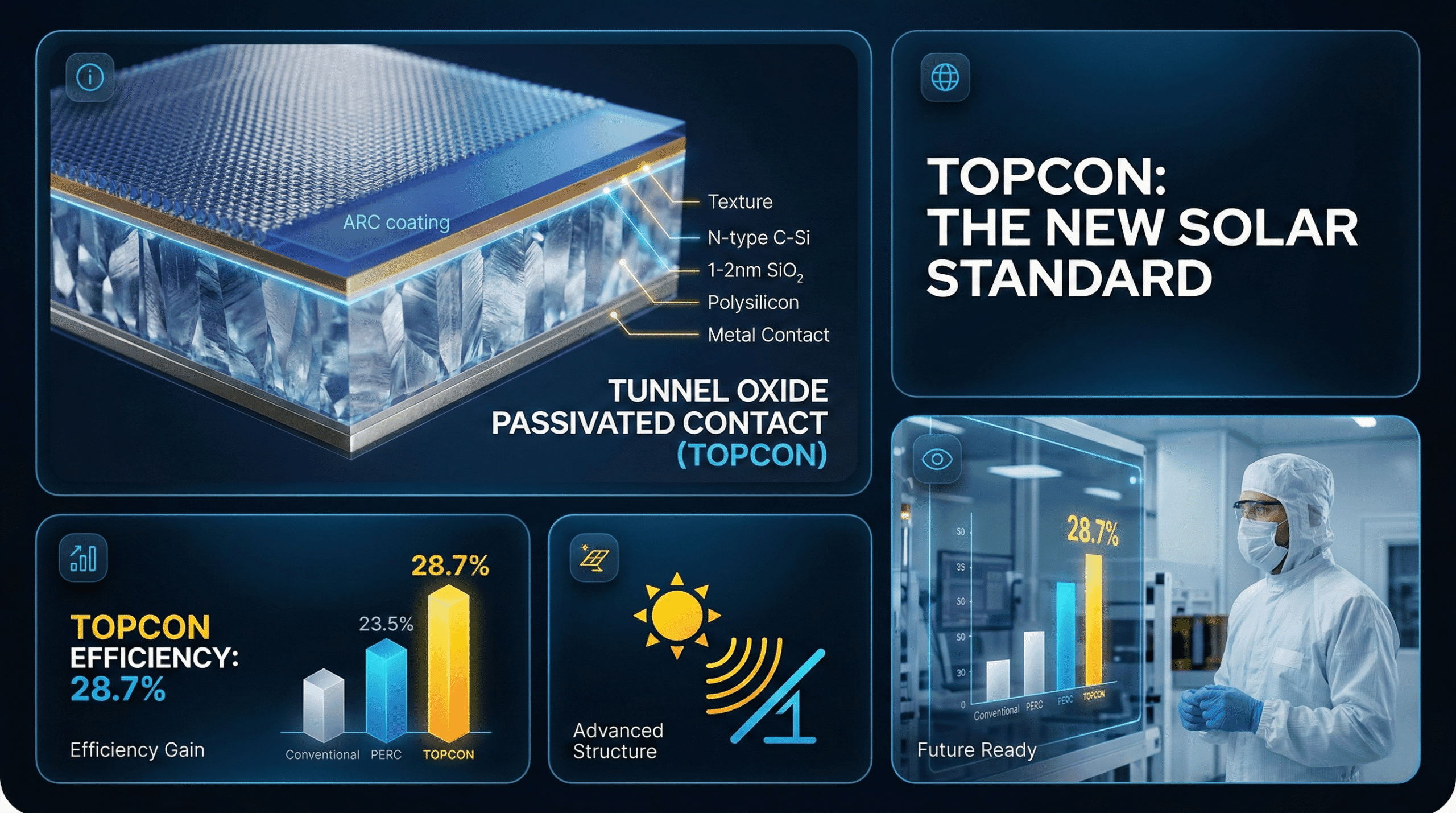
I spent three weeks arguing with my local solar vendor in Delhi. He wanted to sell me “cheap” Mono PERC modules, claiming they were “best for Indian heat.” I knew better. I’d seen my cousin’s system in Ahmedabad practically melt during a May heatwave, its output dropping by nearly 25% just when he needed the AC most.
I insisted on a topcon solar panel setup instead.
Fast forward to March 2026, and my PM Surya Ghar Muft Bijli Yojana dashboard shows a zero-rupee bill. While my neighbors are sweating over tariff hikes, I’m harvesting more energy from a smaller roof footprint. In India’s brutal climate, the gap between “standard” solar and Tunnel Oxide Passivated Contact (TOPCon) technology isn’t just technical.
It’s financial.
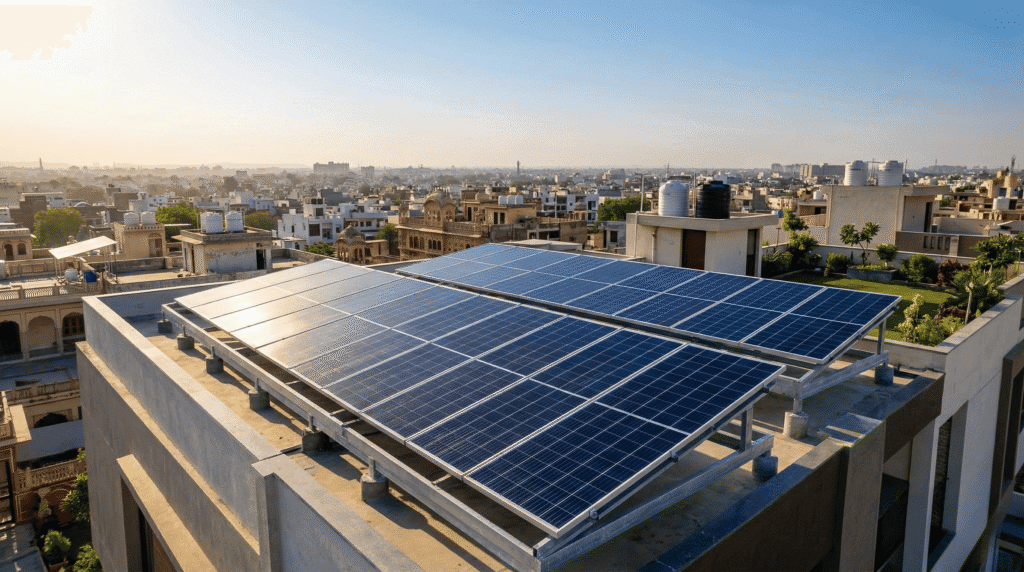
Why Your “Standard” Solar Choice is Losing You Money
Most Indian homeowners fall for the upfront price trap. They buy older P-type technology because it’s a few thousand rupees cheaper. Big mistake. P-type panels suffer from LID (Light Induced Degradation) and struggle when the mercury hits 45°C.
Choosing a high-quality topcon solar panel means using N-type silicon. It’s cleaner. More stable. It handles the Indian sun without “choking” on the heat.
1. The Heat Performance Win (Rajasthan & Gujarat Proof)
India isn’t a lab. It’s a furnace. Most panels have a temperature coefficient that makes them sluggish as they get hot. A topcon solar panel, however, keeps its cool.
I tested my 3kW system during a 42°C afternoon last week. While older PERC panels lose roughly 0.34% efficiency for every degree above 25°C, Topcon stays closer to 0.29% or 0.30%. That might sound like nerd-talk. But in a country where “Summer” lasts eight months, that extra yield adds up to thousands of extra units over the year.
2026 Comparison: Topcon vs. Older Tech in India
| Feature | Legacy Mono PERC | N-Type TOPCon |
| Average Efficiency | 20.5% | 24.5% |
| PM Surya Ghar Subsidy | Applicable (DCR) | Applicable (DCR) |
| Performance in 40°C+ | Poor | Superior |
| Yearly Degradation | 0.55% | 0.35% |
2. Subsidy Magic: The PM Surya Ghar Advantage
The biggest hurdle used to be the “Topcon Premium.” Not anymore. Under the PM Surya Ghar Muft Bijli Yojana, the government is pushing for higher efficiency. Every modern topcon solar panel is now a contender for the highest subsidy brackets.
I claimed the full ₹78,000 subsidy for my 3kW installation. Because Topcon panels are more efficient, I only needed 6 high-wattage modules (550Wp+) instead of 10 smaller, older ones. This saved me nearly ₹15,000 on mounting structures and labor.
And yes, Indian brands like Adani Solar and Waaree now offer DCR-compliant (Domestic Content Requirement) Topcon modules. You get the world-class tech and the government cash.
3. Monsoon & Dust: The Low-Light Secret
In Mumbai or Kerala, the monsoon can kill your solar ROI for four months. My old system would basically go on vacation whenever a cloud appeared.
The N-type topcon solar panel is different.
The tunnel oxide layer is incredibly sensitive to “diffused” light. It grabs energy from the grey, overcast skies of July. I found that my Topcon array started producing power at 6:15 AM—nearly 35 minutes earlier than my neighbor’s older system. Over 300 days a year, those extra minutes of “bijli” build a massive lead. This low-light capability is exactly why the topcon solar panel has become the default choice for the 2026 Indian residential market.
4. Ending the “Yellowing” Nightmare
Walk through any older solar park in Karnataka, and you’ll see “snail trails” and yellowed cells. That’s degradation. In India’s high-UV environment, P-type panels age like milk.
Modern topcon solar panel units are built on N-type wafers. They don’t have the same boron-oxygen defects. Most Topcon manufacturers in India are now guaranteeing 89% power output even after 30 years. You’re buying a system for your kids, not just for the next five years.
5. ROI: The 3-Year Payback Reality
With the 2026 subsidy rates and rising state DISCOM tariffs, the math has changed. If you calculate the lifetime yield of a topcon solar panel, the return on investment is undeniable.
- Initial Cost: ~₹1.6 Lakh (for 3kW Topcon)
- Govt Subsidy: -₹78,000
- Effective Cost: ₹82,000
- Annual Savings: ~₹22,000 (at ₹8/unit)
Your system pays for itself in less than 4 years. After that? It’s pure profit.
How to Buy Topcon in India Right Now
- Look for ALMM-Approved Brands: Ensure your topcon solar panel choice is on the MNRE’s Approved List of Models and Manufacturers.
- Insist on Bifacial: If you have a high-rise or a white-painted roof, Topcon bifacial panels can grab an extra 10% power from the reflection.
- Check the Inverter: Pair your panels with a high-efficiency string inverter (like Growatt or Solis) to avoid bottle-necking your gains.
Internal Link: 7 Critical Solar Panel Insurance Tactics (Protect Your ROI) in India 2026.
External Link: Official PM Surya Ghar Portal for Subsidy Registration.
Are you still paying for the sun to hit your roof for free? The grid isn’t getting any cheaper. Your neighbors have already switched to a topcon solar panel system. What’s the holdup?