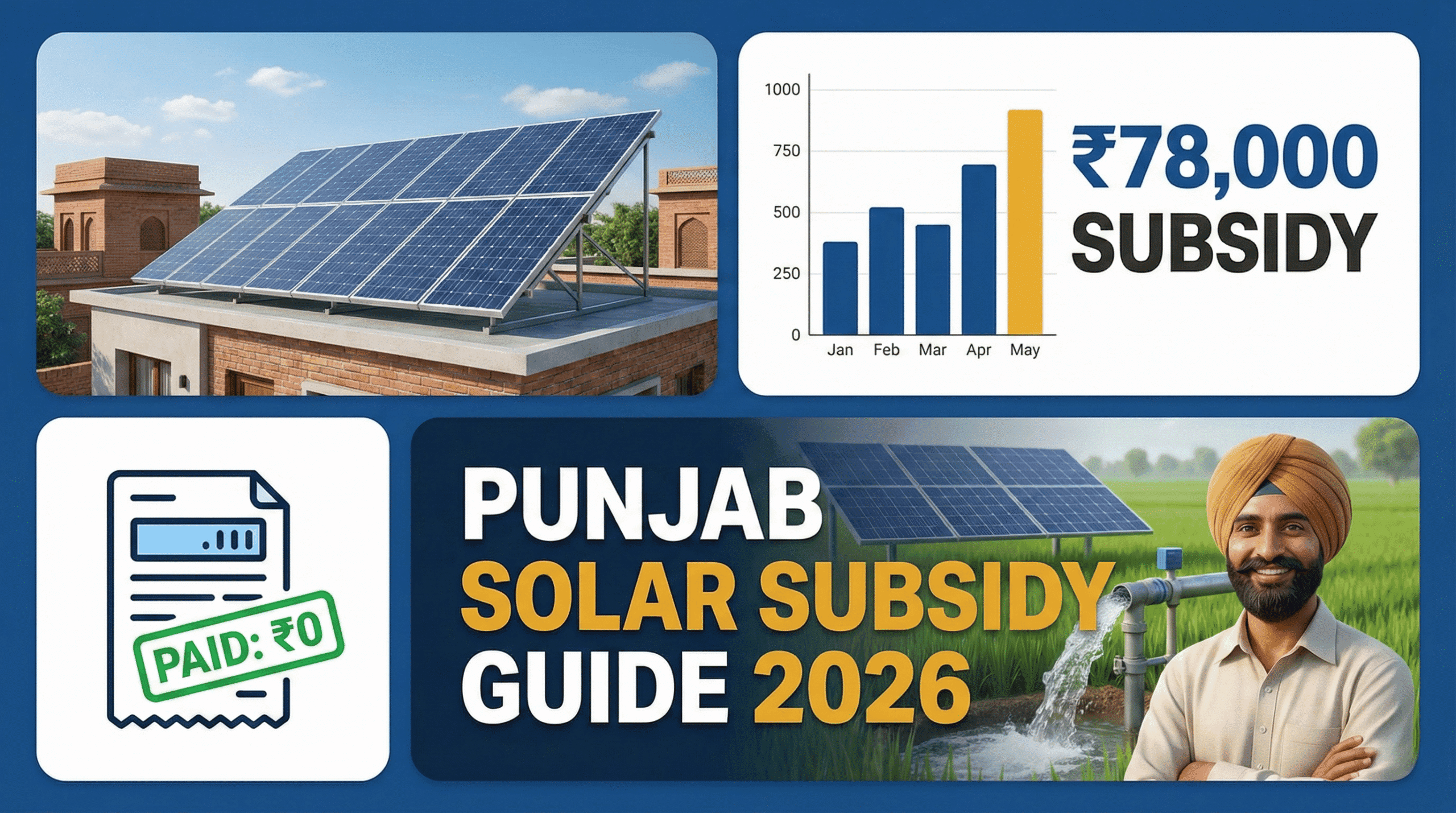
Last summer, my neighbor in Ludhiana nearly had a heart attack when his electricity bill hit ₹18,000. He wasn’t even running all the ACs. That was the day he finally stopped talking about “thinking about it” and actually looked into the subsidy on solar panels in Punjab. Within three months, his bill dropped to zero. Actually, the department now owes him credits.
If you’re still paying full price for power in the land of five rivers, you’re essentially throwing money into a furnace. Between the central PM Surya Ghar Muft Bijli Yojana and state-specific agricultural pushes, the financial math has never been this lopsided in your favor.
1. The ₹78,000 Cash Back: PM Surya Ghar Muft Bijli Yojana
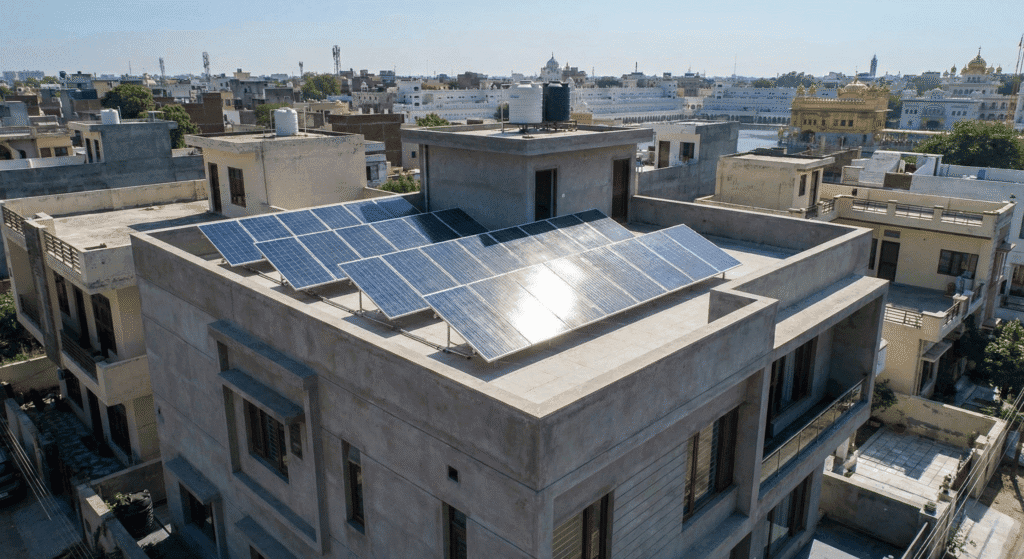
The biggest player in the game right now is the national rooftop scheme. For most homes in Jalandhar or Patiala, a 3kW system is the sweet spot.
Why? Because the government practically hands you the money.
- 1kW to 2kW: You get ₹30,000 per kW.
- 3kW and Above: You get a flat subsidy on solar panels in Punjab worth ₹78,000.
I’ve seen families try to over-engineer their systems by installing 10kW when they only need 5kW. Don’t do that. The subsidy caps out. Stick to what your “sanctioned load” on your PSPCL bill allows, or you’ll find yourself stuck in a bureaucratic loop that feels like dragging concrete uphill.
2. Agricultural Gold: The 80% Solar Tubewell Discount
If you’re a farmer, the deal is even more aggressive. The Punjab Solar Tubewell Scheme 2026 (often linked to PM-KUSUM) is designed to kill off diesel costs.
In my recent fieldwork near Bhatinda, I met a wheat farmer who switched his 15HP diesel pump for a solar-powered unit. He only paid 20% of the cost. The government covered the rest. That’s an 80% subsidy on solar panels in Punjab specifically for agricultural pumping.
- General Category: 60% subsidy.
- SC Farmers: Up to 80% subsidy.
Wait. There’s a catch. You can’t have an existing electric motor connection if you want this specific grant. The state wants to move people off the grid, not add more load.
3. Industrial Relief: Beyond the Home Rooftop
Businesses in Mandi Gobindgarh or the industrial hubs of Ludhiana often feel left out. They shouldn’t. While the direct cash subsidy on solar panels in Punjab for residential homes is more famous, industries get massive tax breaks.
We’re talking about “Accelerated Depreciation.” You can write off 40% of the system cost in the very first year. Plus, you’re exempt from “Electricity Duty” and “Octroi” on solar equipment. For a factory owner, this isn’t just a green move; it’s a cold, calculated survival strategy against rising industrial tariffs.
4. How to Apply Without Losing Your Mind
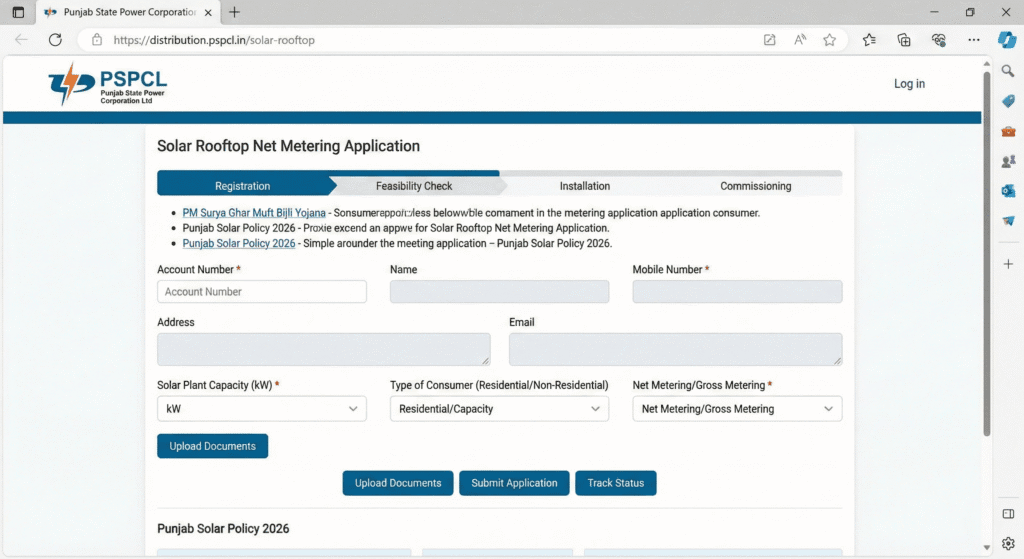
The process is 100% digital now. No more chasing officials at the PEDA (Punjab Energy Development Agency) office.
- Register: Head to the National Portal (pmsuryaghar.gov.in).
- Select DISCOM: Choose Punjab State Power Corporation Ltd (PSPCL).
- Feasibility Approval: Your local JE (Junior Engineer) will check if your transformer can handle the extra juice.
- Install: Use only an empaneled vendor. If you use a random guy from the market, you get zero subsidy on solar panels in Punjab. Hard rule.
5. The “I” Factor: Why My First Installation Almost Failed
I’ll be honest. When I helped my cousin install his first system in Mohali, we messed up. We bought the panels first and then applied for the subsidy on solar panels in Punjab.
Big mistake.
The inspector rejected it because we didn’t use “DCR” (Domestic Content Requirement) modules. To get the cash, the panels must be made in India. If they’re imported, the government won’t give you a single paisa. We had to rip them out and start over. Check the ALMM (Approved List of Models and Manufacturers) before you sign any check.
6. Net Metering: The Real Money Maker
The subsidy on solar panels in Punjab is just the start. The real magic happens through Net Metering.
In Punjab, we get “annual banking.” If your panels produce excess power in the sunny months of May and June, PSPCL “banks” those units. You can use them in the foggy December days when your panels are barely waking up.
But watch out for the 2026 update. The state is moving toward “Net Billing.” This means the price they pay you for exported power might be lower than what they charge you for imported power. Sizing your system correctly is now more important than ever. Don’t go too big; go just right.
7. New in 2026: Group & Virtual Net Metering
Living in a flat in Zirakpur? No roof space?
That used to be a dealbreaker. Not anymore. The 2026 PSERC (Punjab State Electricity Regulatory Commission) draft finally allows “Virtual Net Metering.” You can invest in a solar plant located elsewhere and get the credits adjusted against your apartment’s bill. This is a game-changer for urban dwellers who want to claim the subsidy on solar panels in Punjab but lack a private terrace.
8. Financing Your Solar Dream
Not everyone has ₹2 lakh sitting in a drawer. That’s fine. Banks like SBI and Punjab National Bank (PNB) now offer “Green Loans” at around 7% interest.
The monthly EMI is usually lower than the electricity bill you’re already paying. It’s a net-positive move from day one. You pay the bank instead of the power company, and after five years, the power is free for the next two decades.
9. Common Traps: Why Applications Get Rejected
I’ve seen hundreds of applications for the subsidy on solar panels in Punjab get stuck in “Pending” hell. Here is why:
- Name Mismatch: If the name on your electricity bill is your grandfather’s and the Aadhaar is yours, you’re toast. Update the bill first.
- Shaded Roofs: If a neighbor’s water tank casts a shadow at 2 PM, your output dies. PEDA inspectors check for this.
- Incorrect Load: If you have a 2kW connection but try to install a 5kW solar system, the JE will block it. You must apply for a “Load Extension” first.
10. Maintenance: The Hidden Truth
People tell you solar panels are “set it and forget it.” They lie.
In Punjab, we have dust. A lot of it. If you don’t wash your panels every two weeks, your efficiency will drop by 25%. You don’t need fancy chemicals—just clean water and a soft brush.
Also, watch the wiring. Monkeys in areas like Pathankot or near the hills love to chew on DC cables. Use conduits. It’s a small cost that saves you a massive headache later.
11. Calculating Your ROI (Return on Investment)
Let’s do some quick math.
A 3kW system costs roughly ₹1.8 Lakh.
Subtract the subsidy on solar panels in Punjab (₹78,000).
Your net cost: ₹1,02,000.
If your monthly bill was ₹4,000, you save ₹48,000 a year.
Your system pays for itself in just over two years. Everything after that is pure profit.
12. The Future: Battery Storage and Off-Grid Life
While the current subsidy on solar panels in Punjab focuses on grid-tied systems, I’m seeing more people ask about batteries.
With “Net Billing” coming, storing your own power at night might become more profitable than selling it back to PSPCL. Batteries are still expensive, but they give you total independence. If the grid goes down, your AC stays on.
13. Vendor Red Flags: Who to Avoid
Not all installers are equal. Some will promise you a higher subsidy on solar panels in Punjab than what is legal just to close the sale.
- Red Flag 1: They ask for the full payment upfront before feasibility approval.
- Red Flag 2: they claim the subsidy will come “instantly.” It takes 30-45 days.
- Red Flag 3: They don’t provide a structure stability certificate. If the next storm blows your panels into the neighbor’s yard, you’re liable.
14. PEDA vs. National Portal: Where to Start?
Stick to the National Portal. While PEDA manages state-level agricultural schemes, the residential subsidy on solar panels in Punjab is now centralized. It’s faster, more transparent, and you can track your money every step of the way.
So, are you going to keep paying the “sun tax” to the grid? Or are you going to grab the subsidy on solar panels in Punjab while the window is still open?
The 2026 quota is filling up fast. If you wait until the summer heat hits in April, you might find the funds have already dried up for the quarter.
What’s stopping you from starting the application today?
Check out our guide on 5 Insane Ways Can Solar Panels Run AC Units (That Actually Work) in 2026