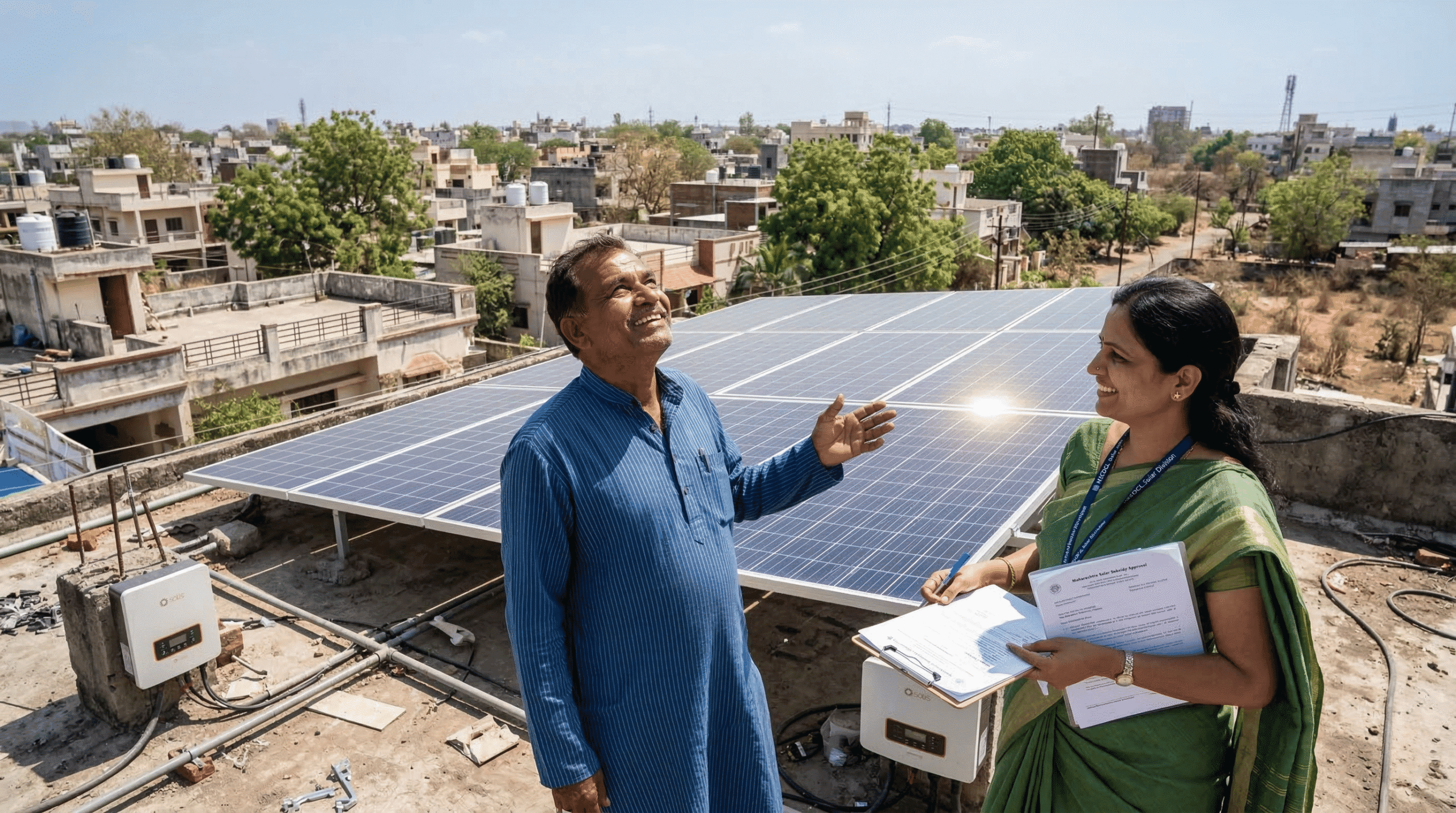
My July electricity bill sitting on the kitchen table in Wardha looked like a ransom note. ₹8,450 for a single month of running air conditioning to survive the punishing Vidarbha summer heat. Bleeding cash to MahaVitaran was no longer an option I could stomach. So, I decided to chase the solar subsidy in Maharashtra to force my monthly expenses down to zero.
I thought grabbing free government money would be a breezy weekend project. I was completely wrong. Navigating the state bureaucracy felt like dragging concrete uphill. But after months of missing documents and rejected forms, I cracked the exact sequence to force the system to pay out.
Why The Solar Subsidy In Maharashtra Causes Instant Headaches
The moment you decide to go green, you hit a massive wall of confusing acronyms. MEDA. MSEDCL. MNRE. It feels designed to make you quit before you even start the paperwork.
Because bureaucracy bites hard. Most homeowners abandon their applications right at the feasibility stage. They upload a slightly blurry property tax receipt, and the portal spits it back out three weeks later.
Getting your piece of the solar subsidy in Maharashtra requires absolute precision. You cannot guess your sanctioned load. You must pull the exact connected load integer directly from your latest MSEDCL bill, or the system auto-rejects you.
The PM Surya Ghar Scheme Reality Check
We are currently operating under the PM Surya Ghar Muft Bijli Yojana framework. This national umbrella dictates how the funds trickle down to our state level. The central government promises up to ₹78,000 for a 3kW system.
But getting that cash into your bank account is a grueling test of patience. You have to register on the National Portal for Rooftop Solar first. And the verification emails sometimes get swallowed by spam folders.
Missing that single verification link resets your entire timeline. You end up waiting another month just to prove you own your own roof. Absolutely maddening.
Choosing Your Hardware Before Touching The Grid
Do not let a desperate vendor sell you unbranded junk. Cheap photovoltaic modules degrade like wet cardboard during the heavy Konkan monsoons. You need industrial-grade resilience to survive our weather patterns.
I specifically demanded Waaree Energies or Tata Power Solar panels from my installer. They cost a fraction more upfront. But they actually generate the wattage promised on the spec sheet.
7 Monocrystalline vs Polycrystalline Solar Panels Facts: Brutal Truths
A bad panel will bleed your efficiency dry. Your generation drops, and suddenly your net meter shows you owing the utility company money again. Never compromise on the actual glass and silicon.
Inverters: The Hidden Brains Of The Operation
Most buyers completely ignore the inverter. They obsess over the black glass on the roof and forget the metal box bolted to the wall. This is a fatal mistake.
The inverter dictates how smoothly your generated direct current translates into usable alternating current. I went with a Growatt string inverter for my setup. Solis is another rugged brand that survives the dusty conditions out here.
If your inverter fries during a grid fluctuation, your entire system goes dead. And you lose weeks of generation waiting for a warranty replacement. Choose heavy-duty internal components.
The Net Metering Trap You Must Avoid
Installing the panels is only fifty percent of the battle. The true nightmare begins when you apply for a net meter from your local MSEDCL subdivision. Bureaucrats move at their own agonizing pace.
My local inspector in Wardha delayed his visit twice because his jeep was supposedly out of fuel. I had glass on my roof catching sunlight for three weeks, completely disconnected from the grid. Generating absolutely nothing.
You have to constantly visit the subdivision office. Bring physical copies of your stamped documents. External Link: View the official MERC Net Metering Regulations here. Read the actual legal code so they cannot lie to you about the timelines.
Surviving The “L1 Vendor” Disaster
The national portal forces you to choose an empanelled vendor. Many buyers simply sort the list by price and pick the cheapest option. This is known as the L1 trap.
These bottom-tier installers survive on razor-thin margins. They use galvanized iron structures instead of pure aluminum. They use thin DC cables that heat up and melt under heavy loads.
Always demand a site visit before signing any agreement. Look at the gauge of the wires they plan to use. Quality wiring prevents your house from catching fire during a power surge.
Financing Your Setup Without Draining Savings
Even with the solar subsidy in Maharashtra softening the blow, you still have to pay the vendor upfront. The government money only arrives in your account after the system is fully commissioned.
I did not have ₹1.5 lakh sitting idle in my savings account. I walked into a Bank of Maharashtra branch to ask about their specific rooftop financing products. SBI also offers a dedicated Surya Shakti loan with surprisingly low interest rates.
These banks disburse the loan directly to your vendor. You only pay a minor processing fee. The EMI is usually less than what your old electricity bill used to be.
Hidden Structural Costs Nobody Mentions
Vendors hate talking about civil work. If your roof is uneven, you need custom elevation structures. This instantly breaks the generic quote they gave you over the phone.
I had an overhead water tank casting a shadow across my primary terrace. We had to build a custom raised mounting structure to clear the shadow line. That added ₹12,000 to my final invoice.
Shadows are the absolute enemy of power generation. Even a tiny shadow from a neighboring chimney can throttle the output of an entire string of panels. Map your roof sunlight across all hours of the day before drilling holes.
Earthing Systems and Lightning Strikes
Do not let them install cheap chemical earthing pits. The rocky soil in the Deccan plateau requires deep, proper copper-bonded earthing rods. Otherwise, a single monsoon thunderstorm will fry your entire investment.
My installer tried to cut corners with standard galvanized iron strips. I physically stopped the workers and made them fetch genuine copper wire. You cannot gamble with lightning.
A proper lightning arrester mounted above your highest panel is non-negotiable. It pulls the static charge away from your sensitive electronics. Demand photographic proof of the earthing depth.
The Inspection Day Chaos
Getting the Chief Electrical Inspector to Government (CEIG) clearance is mandatory for larger setups. Even for residential systems, the local Junior Engineer has to sign off on the installation. They check everything.
They will pull out measuring tapes to check the distance between your panels and the roof edge. They test the anti-islanding feature of your inverter to ensure it shuts down during a grid blackout. If it fails, they reject the whole project.
I watched the inspector flip the main breaker. The inverter clicked, whined, and successfully severed the connection in milliseconds. He finally stamped my file.
Waiting For The Money To Drop
Once the net meter spins backward, you submit the final commissioning report to the portal. Then, the waiting game begins. You check your bank account every single morning.
The portal status will sit at “Pending Sanction” for what feels like a lifetime. The state agency has to verify the physical meter reading against the uploaded photographs. They cross-reference your original application details.
Mine took forty-two days to clear. One random Tuesday, an SMS pinged my phone with a credit alert. The subsidy had finally hit my ledger.
Maintenance Realities In Dusty Cities
Owning a system requires physical labor. The dust in central India coats the panels in a thick, brown film within days. Rain helps, but it mostly just turns the dust into baked mud.
I bought a telescopic water brush with a micro-fiber head. Every Sunday morning at 6 AM, I climb the stairs and scrub the glass. External Link: Study on how soiling reduces photovoltaic output.
If you skip cleaning for a month, your generation drops by twenty percent. That directly impacts your savings and extends your break-even period. You have to treat the panels like a prized vehicle.
The Long Term Financial Reality
My electricity bill is now a negative number. I bank extra units during the winter when the air conditioners are off. I burn those banked units during the brutal summer months.
The initial frustration with the solar subsidy in Maharashtra was agonizing. The paperwork tested my sanity. The delays made me question the entire project.
But looking at a zero-rupee utility bill changes your perspective completely. The grid no longer owns my wallet. Will you keep paying ransom to the power company every month, or are you finally ready to own your own energy?