I stood on a rain-slicked terrace in Bengaluru last monsoon, watching a local contractor try to wedge a 550W Adani bifacial panel into a space designed for a 335W poly module. It was a disaster. The panel overhung the parapet wall by six inches, creating a massive wind-lift risk that could have ripped the whole array off in a storm. We had to pause the entire install because the solar panel size chart used in the planning phase was five years out of date.
Don’t let your “Muft Bijli” dream turn into a structural nightmare.
In the Indian context, space is a premium. Whether you’re dealing with a congested Delhi rooftop or a sprawling farm in Gujarat, the physical footprint of your panels determines your ROI.
Why Indian Roof Dimensions Kill Your ROI
If your panels are too large for your RCC (Reinforced Cement Concrete) slab, you lose walking space for maintenance. If they’re too small, you won’t meet the generation targets for the PM Surya Ghar subsidy. Checking a localized solar panel size chart is the only way to avoid this trap.
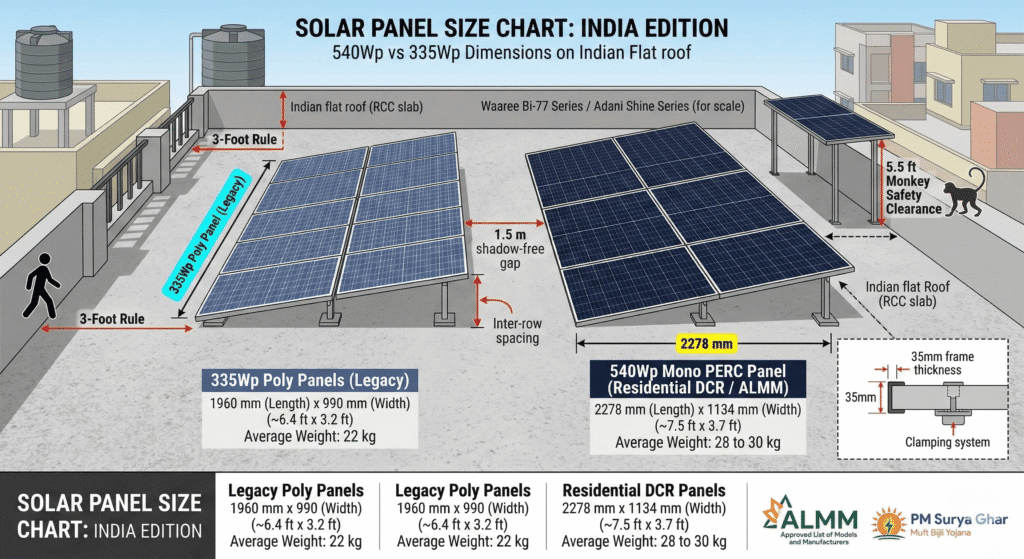
The Standard Solar Panel Size Chart (India Edition)
The Indian market has shifted rapidly. Old polycrystalline panels are being replaced by high-efficiency Mono PERC and TOPCon modules from brands like Waaree, Adani, and Tata Power.
1. Residential DCR Panels (540W – 550W)
These are the current standard for “Domestic Content Requirement” (DCR) projects. They are mandatory if you want to claim the government subsidy.
- Dimensions: Roughly 2278 mm x 1134 mm (approx. 7.5 ft x 3.7 ft).
- Average Weight: 28 to 30 kg.
- Best For: PM Surya Ghar installs on flat RCC roofs.
2. Legacy Poly Panels (335W – 350W)
You still see these in older stock or budget off-grid setups.
- Dimensions: Roughly 1960 mm x 990 mm (approx. 6.4 ft x 3.2 ft).
- Average Weight: 22 kg.
- Best For: Small sheds or replacing broken panels in old arrays.
Choosing the Right Brand for Your Space
Wattage isn’t the only factor. Different Indian manufacturers have slight variations in their solar panel size chart specs that can make or break a tight layout.
- Waaree Bi-77 Series: Known for pushing 670W+ but measures a massive 2384 mm in length.
- Adani Shine Series: Focuses on 540W-580W ranges with a more standard 2278 mm footprint, making it easier to fit on standard 10×10 roof sections.
But wait. What about the “shadow-free” area?
In India, the sun’s angle means you need to leave roughly 1.5 to 2 meters of gap between rows to avoid inter-row shading. If your solar panel size chart calculations don’t include this “dead space,” your generation will tank by 30% in the winter.
[Image Placeholder: Shading analysis and row spacing for an Indian solar panel size chart]
PM Surya Ghar: Size Requirements for Subsidy
Under the new Muft Bijli Yojana, most households aim for a 3kW system. Before you apply, you must consult a solar panel size chart to ensure your roof can actually hold the capacity.
- 3kW System: Usually requires 5 to 6 panels (540Wp each).
- Total Space Needed: Roughly 250 to 300 sq. ft. of clear, shadow-free roof.
- Weight Load: Indian roofs are typically designed for 30kg/sq.m. Most modern panels fall well within this, but the mounting structure adds weight.
Technical Specifications Table (Top Indian Brands)
We have compiled this data from the latest ALMM datasheets. This solar panel size chart helps you compare the physical footprint of India’s biggest manufacturers.
| Brand & Model | Technology | Size (mm) | Weight (kg) |
| Adani Shine (550W) | Mono PERC | 2278 x 1134 | 28.5 |
| Waaree Elite (700W) | N-Type TOPCon | 2384 x 1303 | 38.0 |
| Vikram Preos (400W) | Mono PERC | 1722 x 1134 | 21.5 |
| Loom Solar Shark (440W) | Bifacial | 1909 x 1134 | 25.0 |
How to Measure an Indian Rooftop
Forget the floor plan. Indian construction rarely follows the “as-built” drawings. Grab a tape measure and a piece of chalk.
- Identify the “Shadow Zone”: Mark areas shaded by water tanks, parapet walls, or the neighbor’s taller building.
- The 3-Foot Rule: Keep panels 3 feet away from the edge for wind safety and maintenance access.
- Check the ALMM List: Ensure the specific size you choose is on the Approved List of Models and Manufacturers (ALMM) to stay legal.
And don’t forget the monkeys. In many Indian cities, you need a high-clearance structure (5-6 feet) to keep panels out of reach. This higher structure needs a larger “footprint” for the legs, which changes your solar panel size chart planning entirely.
Expert Tips for 2026 Indian Installs
I’ve seen too many people buy panels based on price, only to find they can’t fit enough on their roof to trigger the government subsidy. Use a reliable solar panel size chart to map out your 1kW, 2kW, or 3kW system before you pay a single Rupee.
- Go Bifacial: If you have a white-painted or reflective roof, bifacial panels (like the Adani Elan) can give you 15% more energy from the same footprint.
- Check the Frame: Ensure it is at least 35mm thick to handle high wind speeds in coastal areas like Mumbai or Chennai.
- Use Local Data: Always verify dimensions on the specific DCR datasheet provided by your installer.
So, are you going to guestimate and hope for the best, or are you going to measure that RCC slab properly before the truck arrives?
How much clear, shadow-free space do you actually have between your water tank and the parapet wall?
5 Proven 1kW Solar Panel Price Facts (That Save You Money) in 2026