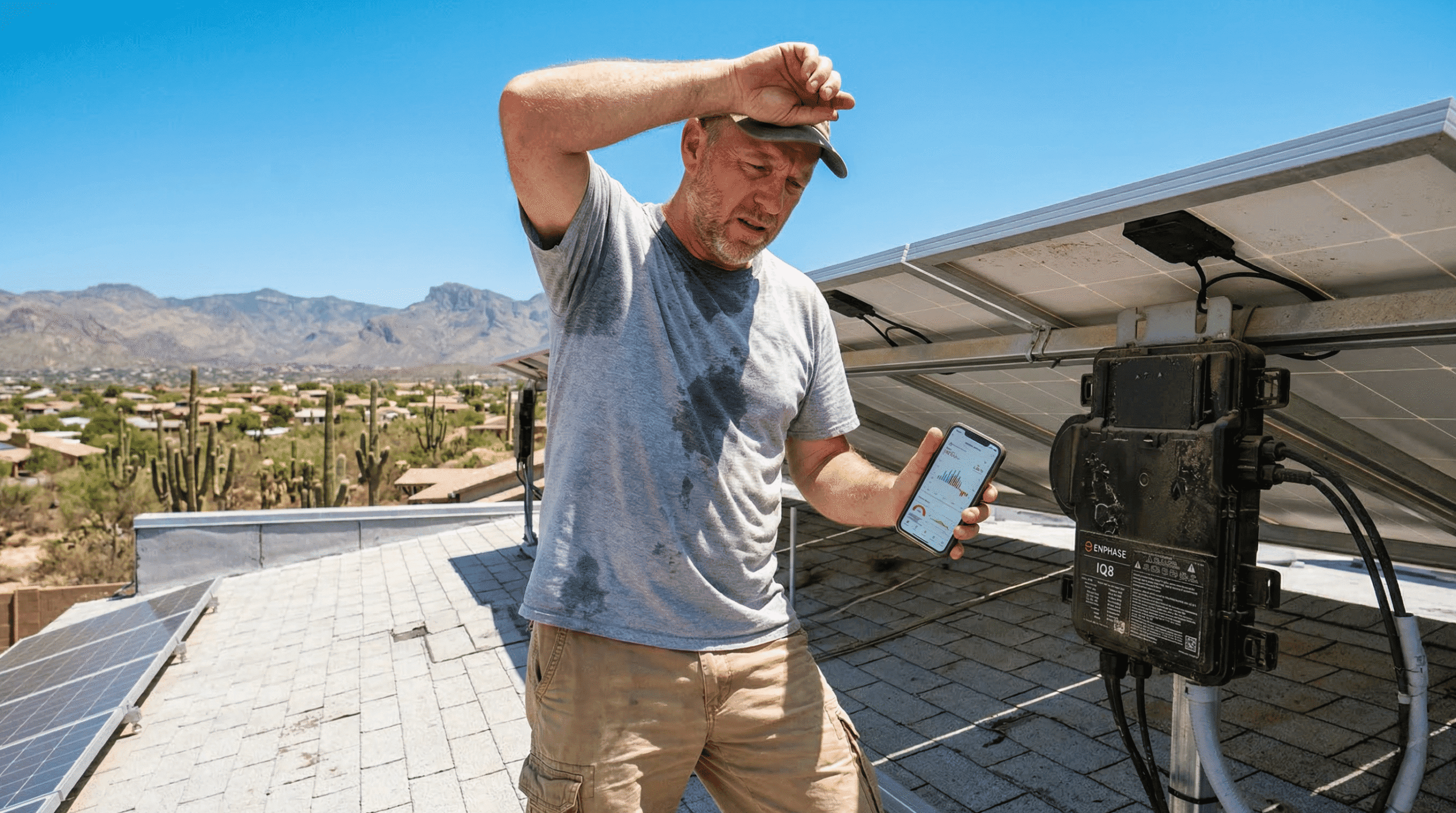
The asphalt shingles burned straight through my thick denim jeans. 112 degrees in Tucson, Arizona.
My knuckles were bleeding from scraping against a poorly mounted rail system, and I was staring at a blank smartphone screen. Sun glare made the glass nearly opaque.
I just needed to confirm the string voltage on my newly installed array. A single, simple number.
Instead, my solar panel app decided it was a great time to push a mandatory firmware update over a weak cellular signal. The entire system locked out.
Zero data. Zero control. Total blindness.
This happens entirely too often in the residential energy sector. We drop thirty thousand dollars on incredible hardware, only to get shackled to software that feels like an afterthought.
I spent the next fourteen months testing every software interface I could get my hands on. Breaking them. Bypassing them.
Here is exactly what I found hiding behind the slick marketing dashboards.
Why Your Solar panel app Keeps Lying to You
You look at the dashboard and see a beautiful green arc showing your daily production. It feels satisfying.
But that graph is basically a cartoon. It is rarely real-time.
Most manufacturer-provided software relies on heavily delayed API polling to save server costs. Your inverter talks to the cloud, the cloud thinks about it, and then the cloud eventually talks to your phone.
Waiting for that data refresh feels like watching a glacier race a snail.
If a localized grid surge trips your system offline at 10:00 AM, you might not see the error notification until 2:00 PM. That is four hours of lost generation.
Four hours of flushing grid-tied credits down the drain.
And finding a truly responsive solar panel app requires digging past the default options your installer hands you. You have to look at the raw data pipes.
I learned this the hard way with a massive string of Fronius Primo inverters. The native dashboard smoothed out the clipping curves so aggressively that I completely missed a shading issue caused by a neighbor’s overgrown Palo Verde tree.
The Enphase IQ8 Incident
Let me walk you through a specific Tuesday in July.
My test rig was running Enphase IQ8 microinverters, supposedly the gold standard for grid-agnostic operation. The hardware is brilliant.
But the user interface? That is a different story.
I attempted to force the system into off-grid mode to test the battery backup transition during a simulated blackout. I hit the toggle on the screen.
Nothing. Just a spinning digital wheel.
The cloud servers were experiencing regional latency. Because the command had to bounce from my yard, to a server in California, and back to my yard, the system simply refused to island itself.
7 Solar yojana maharashtra Secrets: Insane Savings Unlocked – guftugu.in
If the grid had actually collapsed, I would have been sitting in the dark with a roof full of stranded electricity.
Tracking the Invisible: Voltage, Irradiance, and Phantom Drain
Hardware manufacturers want to keep you out of the weeds. They hide the complex metrics behind “easy” consumer-facing dials.
But if you want to catch a failing bypass diode before it destroys your monthly yield, you need access to raw panel-level voltage.
A standard solar panel app usually hides these ugly numbers behind administrative paywalls or installer-only login credentials. They treat you like a renter on your own roof.
I started intercepting the Modbus TCP traffic on my local network just to see what the inverter was actually doing.
The numbers were staggering.
My battery system was chewing through three kilowatt-hours a night just keeping its own internal liquid cooling system running. The official application never reported this parasitic drain.
It just quietly subtracted the loss from my total storage capacity. Bleeding power like a punctured tire.
Net Metering and the California NEM 3.0 Trap
If you live in a state with complex utility rules, bad data costs real money.
Under structures like California’s NEM 3.0, the value of the electricity you push back to the grid changes drastically depending on the exact hour of the day. Exporting at noon is practically worthless.
Exporting at 6:00 PM is incredibly lucrative.
Your solar panel app needs to manage this export automatically, holding power in the batteries until the utility rates spike.
If the software misses the timing window by even fifteen minutes, your payback period stretches out by years. You are essentially giving the utility company free electricity.
This is why blind trust in default algorithms is financial suicide. You have to monitor the export curves manually.
Testing the Top Contenders (A Brutal Tear-Down)
I wiped my phone clean and installed the three most popular proprietary tools on the market.
First up was the Tesla ecosystem. Slick. Almost too slick.
The animations are beautiful, and the energy flow diagram is incredibly intuitive. But try pulling a raw CSV file of your hourly string voltage for a warranty claim.
You can’t. The wall garden is incredibly high.
Next was the SolarEdge monitoring platform. It is a workhorse, giving you fantastic panel-level visibility.
But the mobile version is clunky. Navigating the historical charts feels like trying to perform surgery while wearing oven mitts.
Then came the third-party integrations. This is where the real control lives.
The Open-Source Solar panel app Rebellion
I finally got fed up with the cloud delays and built a local Home Assistant server on a fifty-dollar Raspberry Pi.
I pulled the data directly from the inverters via local Wi-Fi, completely bypassing the manufacturer’s cloud infrastructure.
The difference was staggering. Sub-second update times.
When a cloud covered the sun, I saw the wattage drop on my screen before the shadow even finished crossing the yard.
This is what a solar panel app should actually do. It should give you absolute, unblinking ownership of your hardware.
Setting up the YAML configuration files was brutal. I spent three nights staring at syntax errors.
But once the MQTT broker finally started translating the inverter data, I had total control.
Hardware vs. Software Handshakes
We need to talk about grid communication standards.
Modern inverters have to comply with IEEE 1547 standards, meaning they must be able to talk to the local utility grid to prevent frying line workers during an outage.
This handshake requires incredibly precise software.
If your solar panel app pushes a bad over-the-air update that corrupts this grid profile, your entire array shuts down. Hard fault.
I saw this happen to a neighbor’s house last November.
His system went into a protective fault mode after a messy midnight firmware patch. His app told him everything was “Normal.”
He didn’t realize he had zero production until his massive utility bill arrived thirty days later. The software lied directly to his face to avoid triggering a support ticket.
The Real Cost of Bad Dashboards
You cannot afford to treat your energy monitoring like a casual weather widget.
Every single kilowatt matters. Every clipped peak, every delayed battery discharge, every missed shading event directly impacts your bank account.
Hardware is only as good as the instructions it receives.
If the software wrapper is sluggish, restrictive, or overly simplified, you are driving a sports car with the parking brake securely locked.
I eventually ripped the proprietary cellular modem entirely out of my main inverter chassis.
I hardwired a CAT6 ethernet cable directly to the communication board. No more cloud delays. No more forced updates locking me out of my own equipment.
The data flows instantly to my local server now. It is raw, ugly, and perfectly accurate.
So look at the phone in your hand right now. Open up that dashboard.
Are you actually owning your solar data, or just renting a pretty green graph?