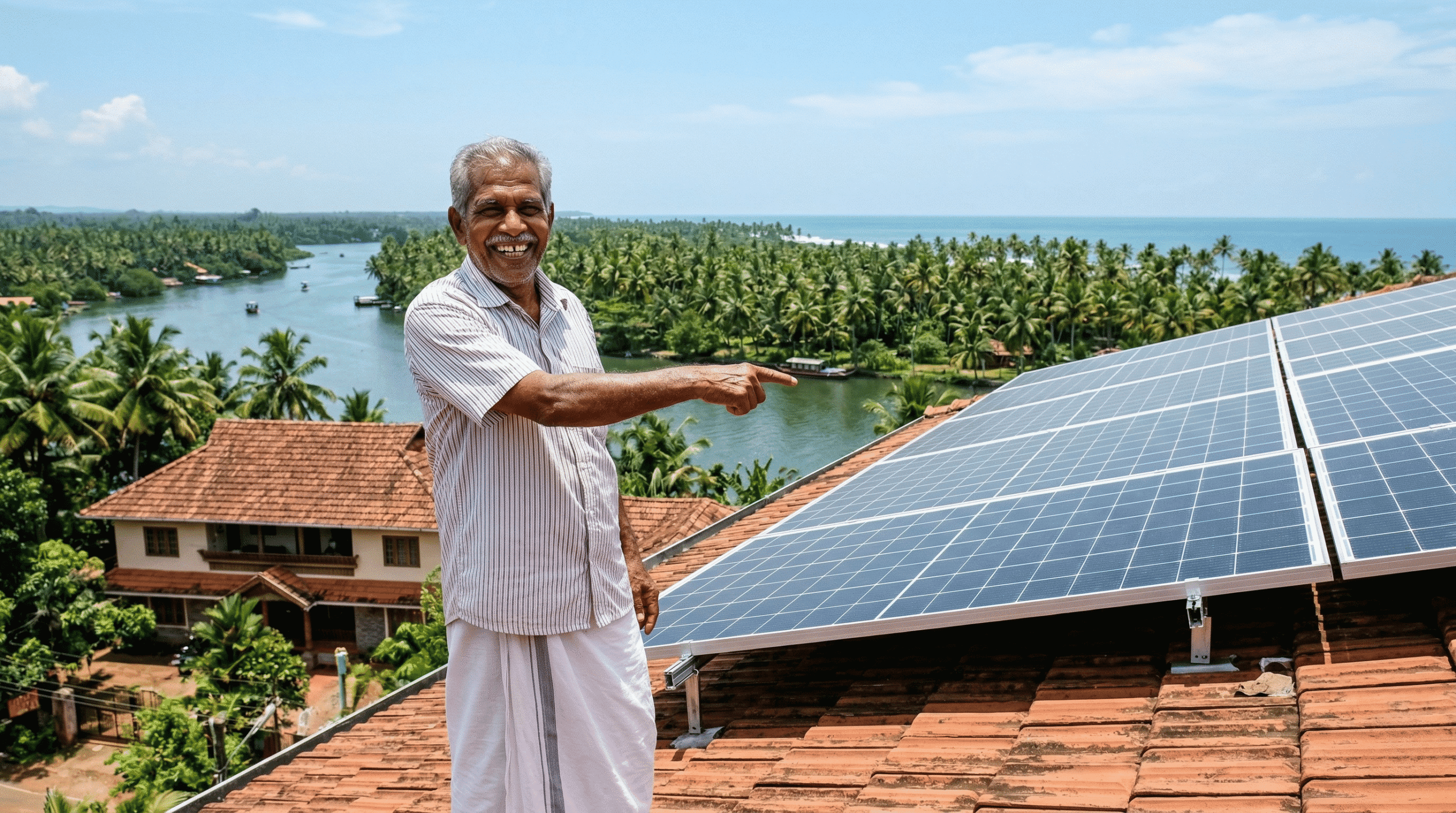
I almost set my roof on fire. Well, not literally, but financially, my first attempt at adopting Solar energy in kerala felt like watching pure cash burn in a barrel. I trusted a smooth-talking vendor in Kozhikode who promised absolute zero electricity bills and vanished the moment the ferocious monsoon onslaught hit.
My imported inverter short-circuited. KSEB completely rejected my grid application. And my wallet? Empty.
But that brutal failure taught me exactly how to navigate this chaotic, unregulated market. Today, the rules dictate a completely different reality for homeowners. The PM Surya Ghar scheme has altered the math, but only if you survive the bureaucratic maze designed to test your patience.
Most homeowners blindly purchase systems without understanding the localized grid constraints. They buy cheap poly-crystalline panels that suffocate and fail in the Palakkad heat. Or they completely ignore the aggressive salt-air corrosion creeping up from the Arabian Sea.
We need to discuss actual numbers and physical realities. Not glossy sales brochures.
The Hidden Trap of Solar energy in kerala Net Metering
Your expensive hardware is utterly useless without proper grid integration. Period.
The Kerala State Electricity Board (KSEB) aggressively regulates net metering applications. This billing mechanism calculates your raw consumption against your total generation. You push excess power back into the local grid during the scorching midday sun.
At night, you draw that power back. Sounds simple, right?
It rarely is. The local transformer capacity dictates your approval status immediately. If your neighborhood transformer hits a 90% renewable capacity threshold, KSEB will flat-out reject your application.
Always secure your official feasibility approval before purchasing a single component. I learned this painful lesson when my 5kW system sat dormant for three infuriating months. I was basically staring at an expensive glass paperweight on my terrace.
Choosing the Right Inverter for Monsoons
Kerala experiences relentless, sideways rainfall. June through August will severely test your electrical hardware.
Standard string inverters frequently die when moisture infiltrates poorly sealed junction boxes. You need IP65-rated metallic enclosures at a minimum. Brands like Deye or Growatt offer rugged hybrid options, but you must verify their official credentials.
If your chosen hardware lacks approval from the Agency for New and Renewable Energy Research and Technology (ANERT), kiss your government grant goodbye. It is that simple.
Cracking the Solar energy in kerala Subsidy Code
Free money always carries heavy strings attached. The Central Financial Assistance (CFA) structure is rigid and unforgiving.
For setups up to 2kW, you receive a direct ₹60,000 grant. Hitting the 3kW mark bumps the financial support to ₹78,000. Anything built beyond 3kW?
The subsidy flatlines. You get exactly ₹78,000, even if you build a massive 10kW plant.
Shady vendors will push you relentlessly to buy a gigantic 10kW system. Why? Because their commission percentage scales directly with the final invoice amount. Resist the aggressive upsell.
The DCR Mandate Nightmare
You cannot just buy high-efficiency imported panels from overseas. The national government enforces a strict Domestic Content Requirement (DCR).
This rule means the raw solar cells themselves must be manufactured within Indian borders. Selecting a tier-1 domestic brand like Vikram Solar or Waaree is absolutely mandatory to claim the PM Surya Ghar funds.
I watched a neighbor in Thrissur lose his entire ₹78,000 grant over a technicality. His greedy installer secretly swapped certified DCR panels for cheap, non-compliant gray-market imports.
Verify the factory serial numbers yourself. Demand the physical paperwork before the installation crew leaves your driveway.
Sizing Your Solar energy in kerala System Correctly
Over-engineering your rooftop is a massive financial bleeding wound. You want to hit the specific “Goldilocks” zone of energy production.
An average four-member household running two air conditioners heavily at night usually consumes 400 to 600 units bimonthly. A standard 3kW system generates roughly 360 units every single month.
That specific output cleanly wipes out the highest, most expensive KSEB tariff slabs.
7 Solar power plant cost Secrets Exposing Massive Hidden Traps – guftugu.in
Do not aim for an absolutely zero-rupee bill. The utility board still charges unavoidable fixed meter rents regardless of your production. Aiming for a negligible ₹150 monthly bill yields the fastest financial return.
The Roof Footprint Mathematics
Usable space is a premium commodity across the state. You need roughly 100 square feet of shadow-free real estate per kilowatt installed.
And I mean completely shadow-free. Zero compromises.
A single swaying coconut frond casting a thin shadow across a string of panels will bottleneck the entire array’s output. It acts exactly like stepping heavily on a running water hose.
Elevated mounting structures offer a brilliant structural workaround. They lift the heavy panels high above parapet walls and preserve your usable terrace space underneath. Just guarantee the galvanized iron framework can withstand extreme wind loads during the Kalakkal storms.
The Solar energy in kerala Installer Blacklist
Anyone owning a ladder and a basic wrench claims to be a renewable expert today. The local market is heavily infested with fly-by-night operators.
Do not ever select a vendor based solely on the cheapest quote. You are essentially marrying this company for a 25-year warranty lifecycle.
If they lack an active, physical service center in your specific district, disqualify them immediately. Waiting three weeks for a broken inverter replacement will slaughter your anticipated monthly savings.
You must verify their active credentials directly through the official government databases.
Avoiding the Warranty Void Trap
Corporate warranties contain vicious, hidden loopholes. Routine physical maintenance is entirely your legal responsibility.
Dust accumulation drastically suppresses energy yields week by week. In our heavily humid climate, that fine dust bakes into a stubborn, sticky grime. If you fail to clean the glass modules regularly, the manufacturer will easily reject your performance claims.
Schedule a strict bi-weekly hose-down. Do it very early in the morning while the glass remains cool to prevent catastrophic thermal micro-cracking.
Financing Solar energy in kerala Through Bank Loans
Paying upfront cash is not the only viable route anymore. The traditional banking sector finally woke up to the massive renewable demand.
Public sector banks now offer collateral-free green loans at interest rates hovering around a reasonable 7%. This specific financial mechanism turns a massive capital expense into highly manageable monthly installments.
Often, the calculated EMI is significantly lower than your old KSEB electricity bill. The system essentially pays for itself automatically.
You simply redirect your existing utility budget toward hard asset ownership. Within four to five short years, the entire loan vanishes. The power you generate becomes practically free for the next two decades.
Reading the Fine Print on Banking Options
Not all financial loans are structured fairly. Read the hidden processing fee clauses with extreme suspicion.
Some private lenders embed aggressive processing fees that completely negate the low-interest illusion. Stick strictly to established banking institutions partnered directly with the PM Surya Ghar initiative.
Cross-reference all local banking policies with the state energy guidelines available at ANERT’s official database.
The Solar energy in kerala Real Estate Valuation Bump
Rooftop hardware isn’t just an electrical appliance. It functions as a highly tangible property upgrade.
Modern homebuyers actively seek properties equipped with pre-installed, grid-tied systems. It guarantees immediate financial immunity against inevitable, massive electricity tariff hikes.
A well-maintained 5kW setup can inflate your total property valuation by a highly significant margin. But the physical installation must look highly professional.
Haphazard dangling wiring and rusting iron mounts will actively repel potential buyers. Treat the visual aesthetics with the exact same rigor as the electrical engineering.
Defeating Coastal Corrosion with Solar energy in kerala
Living right near the beautiful Arabian Sea is visually stunning. It is also an absolute death sentence for cheap metals.
The heavy salt-laden air in locations like Alappuzha or Varkala accelerates oxidation at terrifying speeds. Standard aluminum frames will pit, degrade, and crumble within five short years.
You must specifically demand anodized aluminum or hot-dip galvanized iron coated with a high-micron finish.
Even the tiny fasteners matter immensely. Stainless steel grade 304 or 316 bolts are absolute survival necessities. Anything weaker will snap violently under tension when the inevitable rust sets in.
The Micro-Inverter Advantage
Shading remains the ultimate, silent enemy of power generation. Our dense tropical vegetation guarantees that some part of your roof will likely experience partial shading.
Traditional string inverters choke completely when a single panel drops in voltage. Micro-inverters cleverly solve this structural flaw.
By attaching a miniature inverter to each individual module, they operate completely independently. If a massive jackfruit tree shades one specific panel, the rest of the array continues pumping out maximum voltage.
They definitely cost more upfront. But the massive lifetime yield increase easily justifies paying the premium price.
Battery Storage vs On-Grid Solar energy in kerala
The state grid remains reliable most of the time. But frustrating power cuts still plague certain rural districts regularly.
Homeowners constantly ask if they should purchase massive battery banks. An off-grid or hybrid system utilizes expensive lithium iron phosphate (LiFePO4) storage blocks.
These chemical batteries are fiercely expensive. They will essentially double your total initial project cost.
Furthermore, all chemical batteries degrade over time. You will likely face the agonizing cost of replacing them within eight to ten years.
Why Pure On-Grid Wins
For 90% of urban residents, pure on-grid makes the most brutal mathematical sense.
Let the utility board act as your giant, invisible battery bank. You aggressively push power into the grid by day and pull it back seamlessly at night. The bi-directional net meter keeps the exact score.
Skip the heavy chemical batteries unless you run critical, life-saving medical equipment. Or unless you live entirely off the beaten path deep in Wayanad.
Maximize your raw return on investment by keeping the system incredibly lean and simple.
The Hidden Costs of Solar energy in kerala
Slick salesmen deliberately omit the painful peripheral expenses. Let’s drag those hidden costs into the harsh light.
Heavy copper cable lengths dictate a significant chunk of your final bill. The standard vendor quote only covers a short, specific distance from the roof to your main distribution board.
If your sprawling house requires complex, extended routing, prepare to pay heavily per extra meter.
Upgrading your existing electrical panel represents another frequent, nasty surprise. Older houses in Kottayam or Pathanamthitta often lack modern, safe grounding systems.
You will need to install dedicated chemical earthing pits for the array to satisfy strict electrical inspectorate safety standards.
Insurance and Catastrophic Liability
Your standard homeowner’s policy rarely covers exterior rooftop power plants by default.
A severe, direct lightning strike can instantly vaporize your inverter in a fraction of a second. The state experiences intense, violent lightning activity during the heavy pre-monsoon showers.
You must explicitly add the new hardware to your existing insurance coverage immediately. The tiny annual premium increase is completely negligible compared to the massive replacement cost of a fried 5kW hybrid unit.
The Bureaucratic Maze of Solar energy in kerala
Applying for the government subsidy is not a casual, lazy afternoon task. It requires meticulous, frustrating documentation.
You begin by registering on the central portal using your exact consumer number. A single spelling mismatch between your Aadhaar card name and the utility bill will trigger an immediate, automated rejection.
You must also ensure your local property tax receipts are entirely up to date. Once registered successfully, the agonizing wait for the official feasibility study begins.
The Brutal Inspection Gauntlet
After the physical installation, the real bureaucratic test arrives. The local electrical inspectorate and utility officials will aggressively scrutinize the site.
They hunt mercilessly for specific safety compliance markers. Are the thick DC cables enclosed in proper fire-retardant conduits? Is the earthing resistance testing below the acceptable ohm threshold?
Are the required yellow danger boards prominently displayed?
If your cheap vendor cut corners, the officials will flatly refuse to sanction the net meter. You will be left with a dead, useless system sitting on your roof until every defect gets rectified.
Demand a strict pre-inspection checklist from your installer to avoid this humiliating, costly delay.
Maintaining Your Solar energy in kerala Investment
Many buyers completely forget about the chaotic reality of local wildlife. Yes, I am talking about monkeys.
Aggressive macaques love tearing at loose cables. I watched a wild troop in Wayanad absolutely shred unprotected DC wiring on a newly finished roof. You must heavily armor your conduits.
Nothing lasts forever in a harsh tropical environment. Even the highest-quality panels will eventually see their raw output drop below 80% efficiency after 25 years.
Responsible hardware brands are slowly beginning to establish hardware take-back programs. When negotiating your initial contract, aggressively inquire about their end-of-life disposal protocols.
We cannot solve our current energy crisis by recklessly creating a toxic e-waste crisis two decades down the road.
Are you going to audit your roof tomorrow morning, or will you just blindly hand over another massive cheque to the utility board next month?