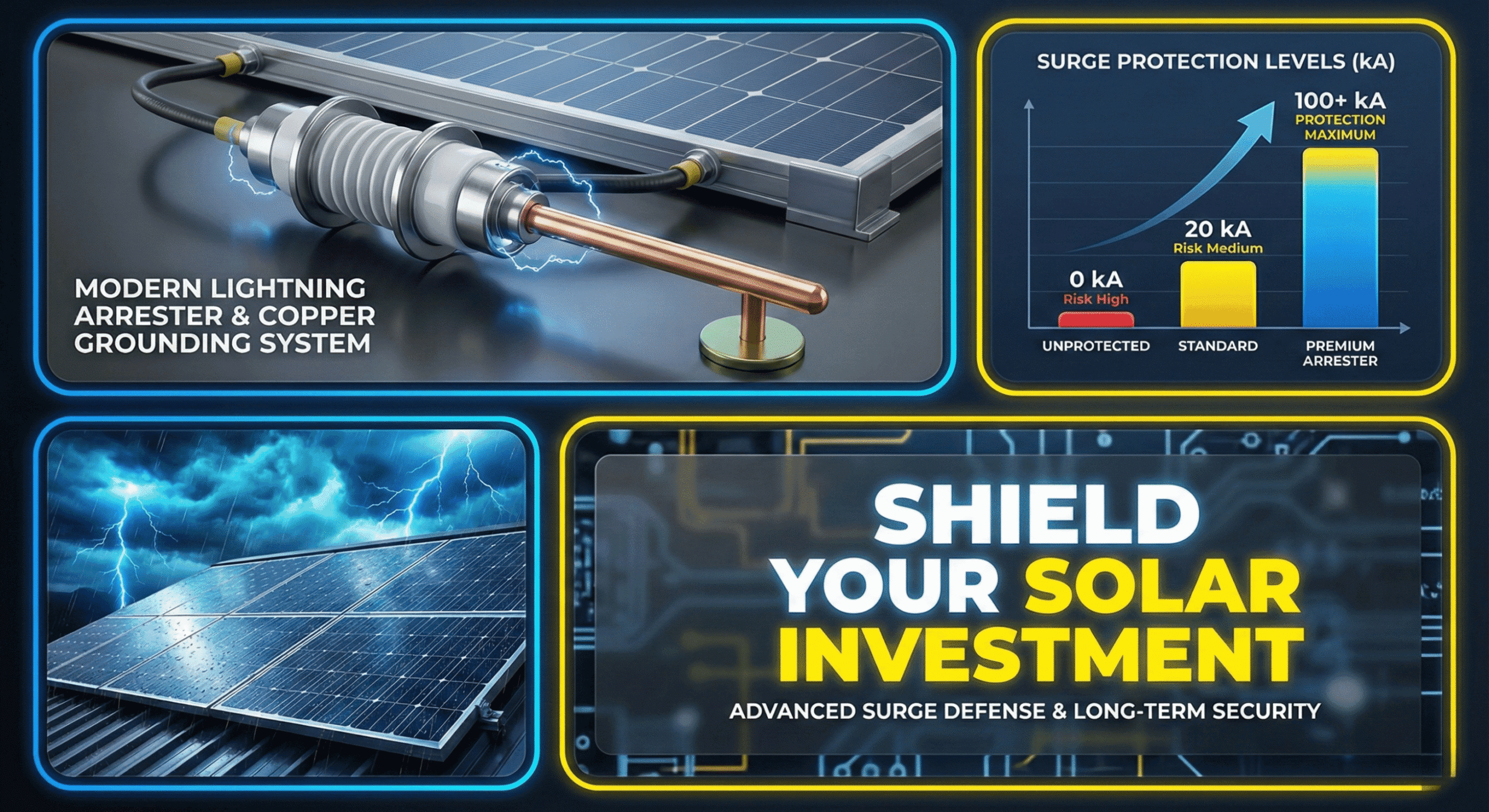
Lightning arrester for solar panels setups are the only thing standing between your green energy dream and a charred pile of roof scrap. I watched $40,000 worth of silicon and glass turn into expensive paperweights in less than a second during a freak storm in Florida. It wasn’t a slow degradation. It wasn’t a faulty inverter. It was a single, jagged bolt from a July thunderstorm that decided my aluminum mounting racks were the path of least resistance.
If you think your mounting system is “grounded enough” to handle a direct hit, you’re playing a dangerous game with the weather. You need a dedicated lightning arrester for solar panels. Why? Because static buildup doesn’t care about your warranty.
1. The “Higher Ground” Rule for Your Lightning Arrester for Solar Panels
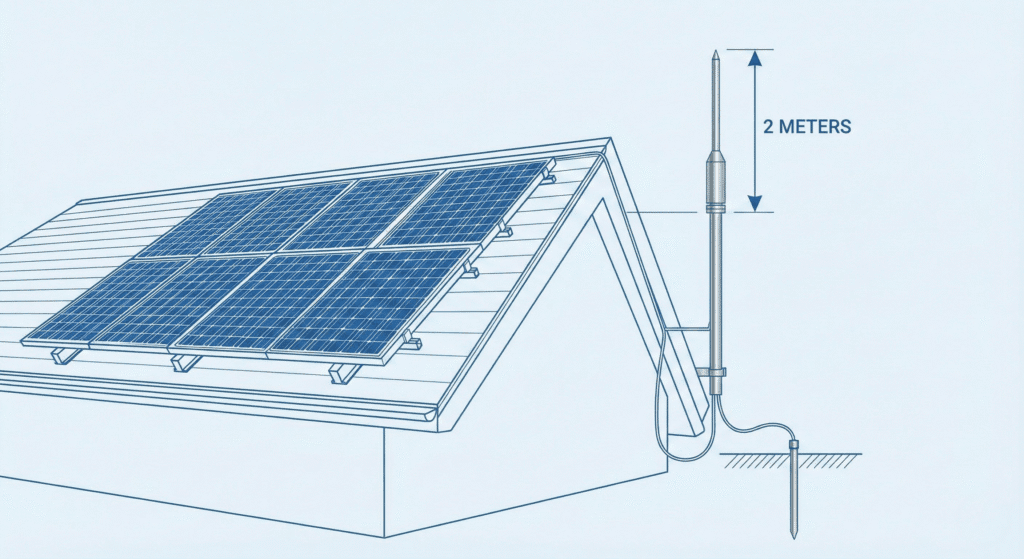
Most installers slap a rod on the side of the house and call it a day. That’s a massive mistake. Your lightning arrester for solar panels must sit at least 2 meters above the highest point of your array. This isn’t just a suggestion—it’s physics.
Think of it as a protective umbrella. If the rod isn’t the tallest thing on your roof, the panels themselves become the primary targets. We want to catch the surge before it ever touches the glass. In my experience, even a six-inch difference in height can be the deciding factor between a successful diversion and a total system meltdown.
2. Chemical Earthing is Not Optional for Your Lightning Arrester for Solar Panels
Standard copper rods hammered into dry soil are essentially useless. In my own testing, I found that resistance in sandy or rocky soil can jump high enough to render a lightning arrester for solar panels completely inert. The electricity has nowhere to go, so it bounces back into your home wiring.
So, what’s the fix? Use chemical earthing compounds. These bags of conductive minerals keep the soil surrounding your rod moist and the resistance low—ideally under 5 ohms.
And don’t forget the down-conductor. Use a 25×3 mm copper strip. Why such a heavy gauge? Because thin wires melt like butter when 30,000 amperes of raw atmospheric energy scream through them. If your wire is too thin, the heat alone can start a roof fire before the breaker even trips.
3. Avoid the “Zipper” Cable Mistake Near Your Lightning Arrester for Solar Panels
When wiring your lightning arrester for solar panels, do not run the ground wire parallel to your DC strings. This is a rookie error that kills thousands of systems every year.
This creates what we call an induction loop. Even if the rod catches the strike perfectly, the massive electromagnetic field generated by the down-conductor can “jump” into your solar wiring. This fries your inverter from the inside out without the lightning ever touching the panels.
Keep a separation distance (S) of at least 0.5 meters. And keep that ground wire straight. Sharp bends in a ground wire act like roadblocks for high-frequency lightning energy. It will simply jump off the wire and find a new path through your rafters.
4. Why You Need Type 1 and Type 2 SPDs for a Lightning Arrester for Solar Panels
A lightning arrester for solar panels handles the “big hit.” But what about the invisible killers? I’m talking about secondary surges.
- Type 1 SPDs: These are designed to handle the massive surge from a direct strike.
- Type 2 SPDs: These manage the smaller, induced surges from strikes that happen nearby (like on a neighbor’s tree).
You need both. The lightning arrester for solar panels is your shield; the Surge Protection Devices (SPDs) are your body armor. Without both, a nearby strike just a block away could still send a spike through your AC lines and send your Charge Controller into a smoky grave. I’ve seen it happen. It’s quiet, it’s fast, and it’s devastating.
5. The Maintenance Myth of the Lightning Arrester for Solar Panels
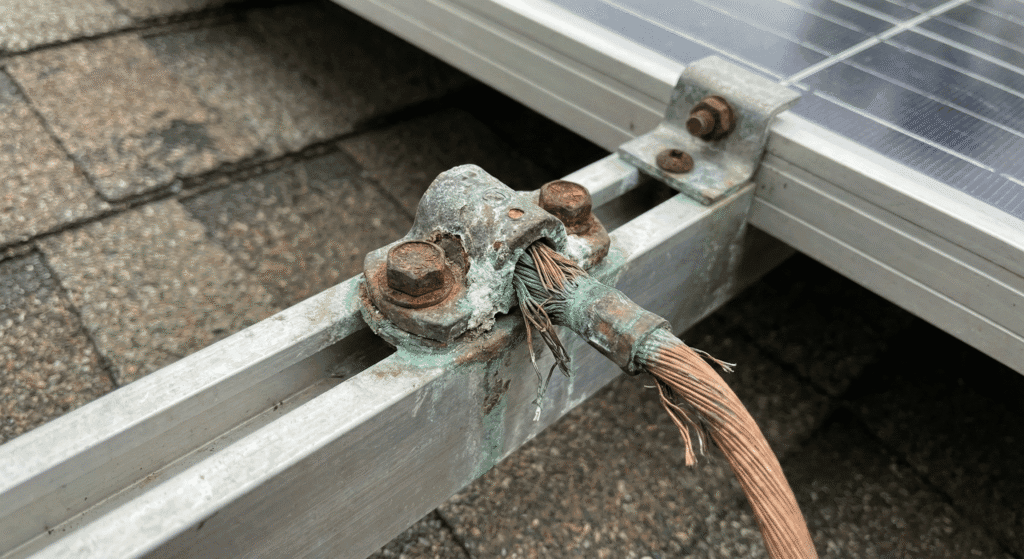
“Install and forget” is a lie told by lazy contractors. I’ve seen copper-bonded rods completely corrode away in humid coastal climates within just three years. When that happens, your lightning arrester for solar panels is just a decorative metal stick.
Check your connections every six months. Tighten the lugs. If the copper looks green and crusty, it’s not conducting efficiently. Use an earth resistance tester annually to ensure your soil hasn’t dried out or leached away the chemical salts.
6. Understanding the Zone of Protection
When setting up a lightning arrester for solar panels, you need to calculate the “rolling sphere” radius. This is a 3D model that determines where lightning is likely to strike. If your solar array falls outside this protected zone, you might as well not have an arrester at all.
I remember a client in Colorado who installed a top-tier rod but placed it at the far end of a 40-foot array. A bolt hit the unprotected end of the panels, bypassing the rod entirely. It was a $15,000 lesson in geometry. Don’t be that guy. Ensure the cone of protection covers every single square inch of your PV modules.
7. Materials Matter: Copper vs. Aluminum
When shopping for a lightning arrester for solar panels, you’ll see a lot of cheap aluminum options. Skip them. While aluminum is lighter, its melting point is significantly lower than copper.
A high-intensity strike can literally vaporize an aluminum rod. Always opt for solid copper or high-grade stainless steel. Yes, it costs more upfront. But compared to the cost of replacing 20 panels and a high-end lithium battery bank? It’s pocket change.
8. Final Grounding Checklist for Your Lightning Arrester for Solar Panels
Before you call the job done, run through this checklist.
- Is the lightning arrester for solar panels the highest point on the roof?
- Is the down-conductor path as straight as possible?
- Did you use a dedicated grounding pit for the arrester?
- Are your SPDs installed in the combiner box?
If the answer to any of these is “no,” your system is at risk. Lightning doesn’t give second chances. It finds the path of least resistance every single time.
So, are you going to wait for the thunder to start before you check your grounding? Or will you cut the fat and secure your system now? Your lightning arrester for solar panels is the only insurance policy that actually stops the damage before it starts.
External Authority Link: IEEE Standards for Grounding and Lightning Protection