I remember sitting in my living room in Bangalore three years ago, staring at a ₹15,500 electricity bill during a brutal April heatwave. It felt like I was being robbed in broad daylight by the utility company. That was the day I went down the rabbit hole to find out how much electricity does a solar panel produce and if it could actually stop the bleeding from my bank account. Most people think you just slap a piece of blue glass on the terrace and wait for the “free money” to roll in. It doesn’t work that way.
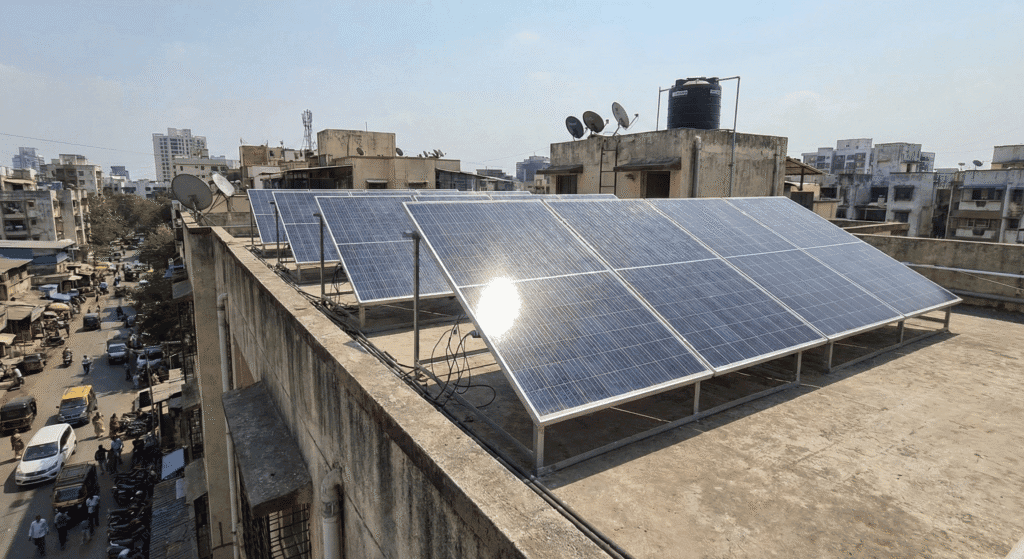
The “Back of the Napkin” Math for Solar Output
If you’re looking for a quick number, a standard 400-watt residential panel in India generally generates between 1.6 kWh and 2.2 kWh of energy per day. But that’s a “perfect world” stat from a lab in Europe. In my own testing with a Waaree 440W module during a particularly dusty March, I saw days where I barely cracked 0.9 kWh.
Why the gap? Because your panel isn’t a light switch.
The formula for figuring out how much electricity does a solar panel produce is actually pretty simple:
Panel Wattage × Peak Sun Hours × System Efficiency (usually 0.8) = Daily Output.
So, if you have a 400W panel and get 5 hours of “peak” sun (common in states like Rajasthan or Gujarat), you’re looking at about 1.6 units (kWh) per day. Multiply that by 30, and you’ve got 48 units a month from a single unit. Knowing exactly how much electricity does a solar panel produce helps you size your system before a salesperson tries to overcharge you.
Real-World Factors That Kill Your Generation
You can buy the most expensive Tata Power or Adani panels on the market, but physics doesn’t care about your budget. Several “silent killers” in the Indian climate will tank your production faster than a monsoon storm.
1. The Temperature Trap (The Indian Paradox)
Common sense says “hotter equals more power,” right? Wrong. I discovered this the hard way during a 45-degree heatwave last June. Solar panels are electronic devices. They hate heat. Once the surface temperature of the cells passes 25°C, efficiency starts to drop by about 0.3% for every degree higher. In India, your panels might reach 70°C on the roof. At that point, the question of how much electricity does a solar panel produce becomes a depressing math problem. You lose nearly 15-20% of your potential power just because the roof is too hot.
2. The “Dust and Smog” Tax
Don’t ignore the soot. In cities like Delhi or Kanpur, air pollution is a massive barrier. I once let my panels sit for a month during the post-Diwali smog, and my monitoring app showed a staggering 25% dip in output. If you aren’t cleaning them, asking how much electricity does a solar panel produce won’t matter because the answer will be “hardly anything.” Just a quick spray with a garden hose every Sunday morning brought it right back. If you don’t clean them, you’re basically burning money.
The PM Surya Ghar Impact: Production vs. Subsidy
With the new PM Surya Ghar: Muft Bijli Yojana, everyone is asking the same thing. How many panels do I need to get that 300 units of free electricity?
To get 300 units (kWh) a month, you need to generate about 10 units a day. If we look at how much electricity does a solar panel produce on average (about 1.6 units for a 400W panel), you’ll need at least 6 to 7 panels. This is roughly a 3kW system. In India, a 3kW system will cost you around ₹1,80,000 before the subsidy. After the government kicks in their share, your out-of-pocket cost drops significantly, but the production stays the same. Understanding how much electricity does a solar panel produce per kilowatt is key to maximizing these government incentives.
How Much Electricity Does a Solar Panel Produce per Month?
To power a whole house in a metro city, you need to look at the big picture. An average middle-class Indian home with two ACs eats up about 600 to 800 units per month during summer.
If one 400W panel gives you roughly 50 units a month, you’re going to need a “gang” of about 12 to 16 panels to wipe out that bill entirely. Most modern systems are sized around 5 kW to 8 kW to ensure you aren’t left in the dark during a rainy week in July. When you calculate how much electricity does a solar panel produce over a full 30-day billing cycle, the savings start to look like a monthly salary.
The E-E-A-T Reality Check: My Failure with Shading
I made a massive mistake when I first installed my DIY setup on the balcony. I ignored a tiny water tank shadow that only appeared after 2 PM.
I thought, “It’s only covering 5% of the panel, no big deal.”
And then I saw the data. Because of how cells are wired in “strings,” that tiny shadow acted like a kink in a garden hose. It knocked my total output down by nearly 50% for that entire string of panels. If you have trees, water tanks, or your neighbor’s taller building casting shadows, the metrics for how much electricity does a solar panel produce will plummet. You absolutely must use half-cut cell panels or microinverters. Otherwise, you’re just decorating your roof with expensive blue glass.
Seasonal Shifts: Monsoon vs. Summer
You have to brace yourself for the “Monsoon Dip.” From June to September, the question of how much electricity does a solar panel produce becomes very volatile. On a heavy overcast day in Mumbai, a 400W panel might only give you 0.4 units.
But here is the secret: panels actually love the rain because it cleans off the bird droppings and dust. Once the clouds part, the clean cells perform better than they did in the dusty summer. Plus, the cooler air helps with that “Temperature Trap” I mentioned earlier. If you track how much electricity does a solar panel produce across all four seasons, you’ll see that winter often outperforms summer due to the cooler cell temperatures.
Is One Panel Enough for Anything?
So, what can a single panel actually run? If your panel produces 1.8 units a day, you can:
- Run a ceiling fan for 15 hours.
- Keep a medium-sized LED TV on for 12 hours.
- Charge your smartphone 100 times.
- Run a 15-watt LED bulb for… well, forever.
It’s great for a remote farm shed or a small gate light, but for a modern house? You need the whole squad. When considering how much electricity does a solar panel produce, don’t just think about the big appliances; think about the cumulative load of every small gadget in your home.
And don’t forget about the “internal” link to your battery storage or the Net Metering system. In India, Net Metering is the real game-changer. Without it, the calculation of how much electricity does a solar panel produce doesn’t matter because you can’t use the excess power at night. You’re sending all that hard-earned juice back to the DISCOM for free while they charge you full price after sunset.
How much are you currently paying for power every month? Is it ₹5,000? ₹10,000? It is finally time to stop renting your energy from a grid that keeps getting more expensive. Truly understanding how much electricity does a solar panel produce is the first step toward total financial independence.
For more technical specs on Indian solar potential, check out the Ministry of New and Renewable Energy (MNRE) or look at global irradiance maps from NREL.gov.
Check out our guide on 10 Insane Solar Panel Manufacturers in Coimbatore (That Save You Thousands) in 2026