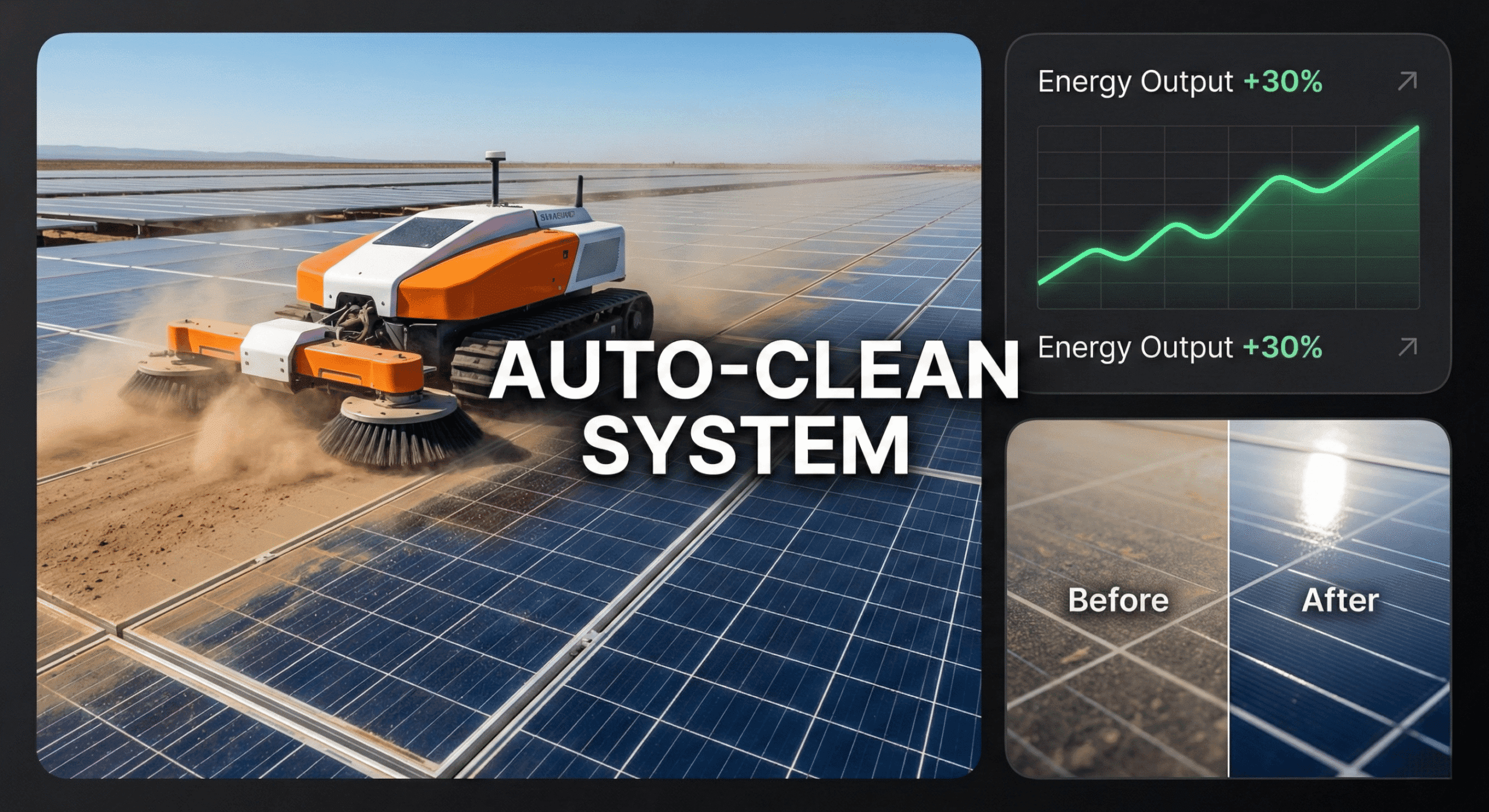
I stared at the monitor, and my stomach dropped. My output was crashing, and I realized I needed an automatic solar panel cleaning system before I went bankrupt.
The graph wasn’t just dipping; it was flatlining. My 500kW array, which should have been printing money in the July sun, was performing like it was underwater. I called my inverter guy. I called the grid operators.
“It’s the hardware,” I insisted. “Something is broken.”
It wasn’t broken. It was dirty.
I had underestimated the “Soiling Loss” factor by a massive margin. A layer of dust, barely visible to the naked eye, was costing me nearly 30% of my daily generation. That is when I stopped relying on rain and guys with squeegees. I went looking for a permanent fix.
If you are reading this, you are probably bleeding revenue too.
Manual washing is slow, expensive, and frankly, dangerous. The solution? A high-performance automatic solar panel cleaning system. But not all robots are created equal. Some will save your business. Others will scratch your glass and die in a month.
Here is what I learned after auditing the best systems on the market.
The “Invisible Thief” Destroying Your ROI
Why panic over a little dust?
Because solar panels don’t just lose power linearly. They suffer from “hard shading.” If a single cell in a module is blocked by bird droppings or heavy dust, it can drag down the performance of the entire string.
In my testing, I found that a simple automatic solar panel cleaning system didn’t just clean the glass; it stabilized the voltage.
MIT researchers found that dust accumulation can slash output by 30% in just one month. In arid regions like Rajasthan or Arizona, that number is conservative. You aren’t just losing a few kilowatts. You are losing the profit margin that made the project viable in the first place.
How the Automatic Solar Panel Cleaning System Actually Works
Forget the image of a car wash. These machines are surgical.
Most high-end systems today fall into two buckets: Waterless Robots and Sprinkler Arrays.
I prefer the robots. Why? Because water is heavy, expensive, and leaves calcium deposits if you aren’t careful. Implementing the right automatic solar panel cleaning system means choosing between hydration and friction.
The Robotic Workflow:
- Docking: The robot sleeps at the edge of the row, charging via its own mini-solar panel.
- Activation: At night (usually 4 AM), it wakes up.
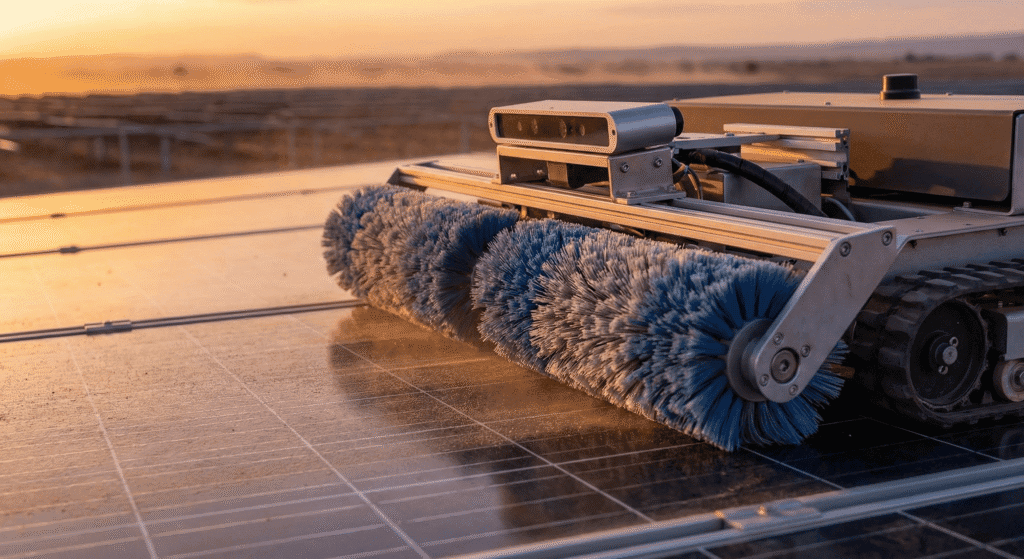
- The Sweep: It moves along the frame, using microfiber brushes to push sand and dust off the edge.
- No Water: It uses airflow and gravity. Zero water usage.
This is the “Ecoppia” model, and it changed the game for me. You set it, forget it, and wake up to 100% efficiency.
The Cost vs. ROI Calculation
Let’s talk money. Because these things aren’t cheap.
A manual cleaning crew charges roughly $0.50 to $1.00 per panel per wash. If you wash four times a year, that adds up. But the real cost isn’t the labor. It’s the time between washes.
Day 1 after a manual wash? 100% power.
Day 89 before the next wash? 70% power.
You are running at suboptimal efficiency for 89 days.
An automatic solar panel cleaning system cleans every single night. You are always at Day 1 efficiency.
My Math:
- Manual: 4 washes/year = average 85% annual efficiency.
- Automatic: 365 washes/year = average 99.5% annual efficiency.
That 14.5% gap? On a megawatt-scale plant, that pays for the robot in under 18 months.
Top Systems Reviewed (The “Survivors”)
I have seen plenty of cheap plastic bots melt in the heat. Avoid them. These are the heavy hitters.
1. Ecoppia (The Gold Standard)
If you have the budget, this is it. Ecoppia dominates the utility-scale market. Their T4 and H4 models are waterless, fully autonomous, and built like tanks. I watched one operate during a sandstorm. It didn’t flinch. It is arguably the most robust automatic solar panel cleaning system available.
2. Solabot (The Heavy Duty Choice)
For projects in India or the Middle East, Solabot is making waves. They focus heavily on “Dry Cleaning” technology. Their suspension systems are better at handling uneven racks than some European models I’ve tested.
3. RST Nightwash (The Sprinkler Option)
Not everyone wants a robot moving parts. RST uses a clipping system that attaches nozzles to the top of your panels. It sprays filtered water at night. It works, but you need a massive water source and filtration system. If you have hard water, do not use this type of automatic solar panel cleaning system.
The Hidden Downside of Automation
I need to be honest with you. It isn’t all magic.
Maintenance of the Maintainers.
Who cleans the cleaner? The microfiber brushes on an automatic solar panel cleaning system eventually get clogged with grit. If you don’t swap them out, you are essentially sanding your glass panels every night.
I check my brush heads every 6 months. It’s a small price to pay, but if you ignore it, you will ruin the anti-reflective coating on your modules.
And battery life? It’s better now, but extreme heat kills lithium. Expect to replace the robot batteries every 3-4 years.
Is It Worth It?
Look at your generation data from yesterday.
If it looks like a flat line, you’re fine. But if it looks like a jagged, declining slope, you are leaving money on the table.
The solar industry is moving toward automation. We have automated inverters, automated trackers, and automated billing. Why are you still relying on a guy with a bucket to protect your most expensive asset?
Installing an automatic solar panel cleaning system felt like a risk when I signed the check. Six months later, looking at a 20% revenue bump, it felt like the only sane choice.
Are you willing to let dust eat your profits for another year?