Sweat dripped onto the ₹8,400 electricity bill. We were sitting in Wardha, a district where the May sun feels like a physical assault.
The local grid was draining our bank account with brutal efficiency. I needed a way out fast. And I needed it to actually work.
This was my abrasive introduction to the Solar yojana maharashtra machinery. The scheme promises massive financial relief for homeowners. But getting there feels like chewing glass.
Most people think grabbing government subsidies involves a simple online form. Wrong. You are stepping into a bureaucratic swamp.
Let me walk you through the exact agony and eventual triumph of getting panels on a blazing concrete roof. I learned the hard way. Now, you get the blueprint.
The Raw Mechanics of the Solar yojana maharashtra
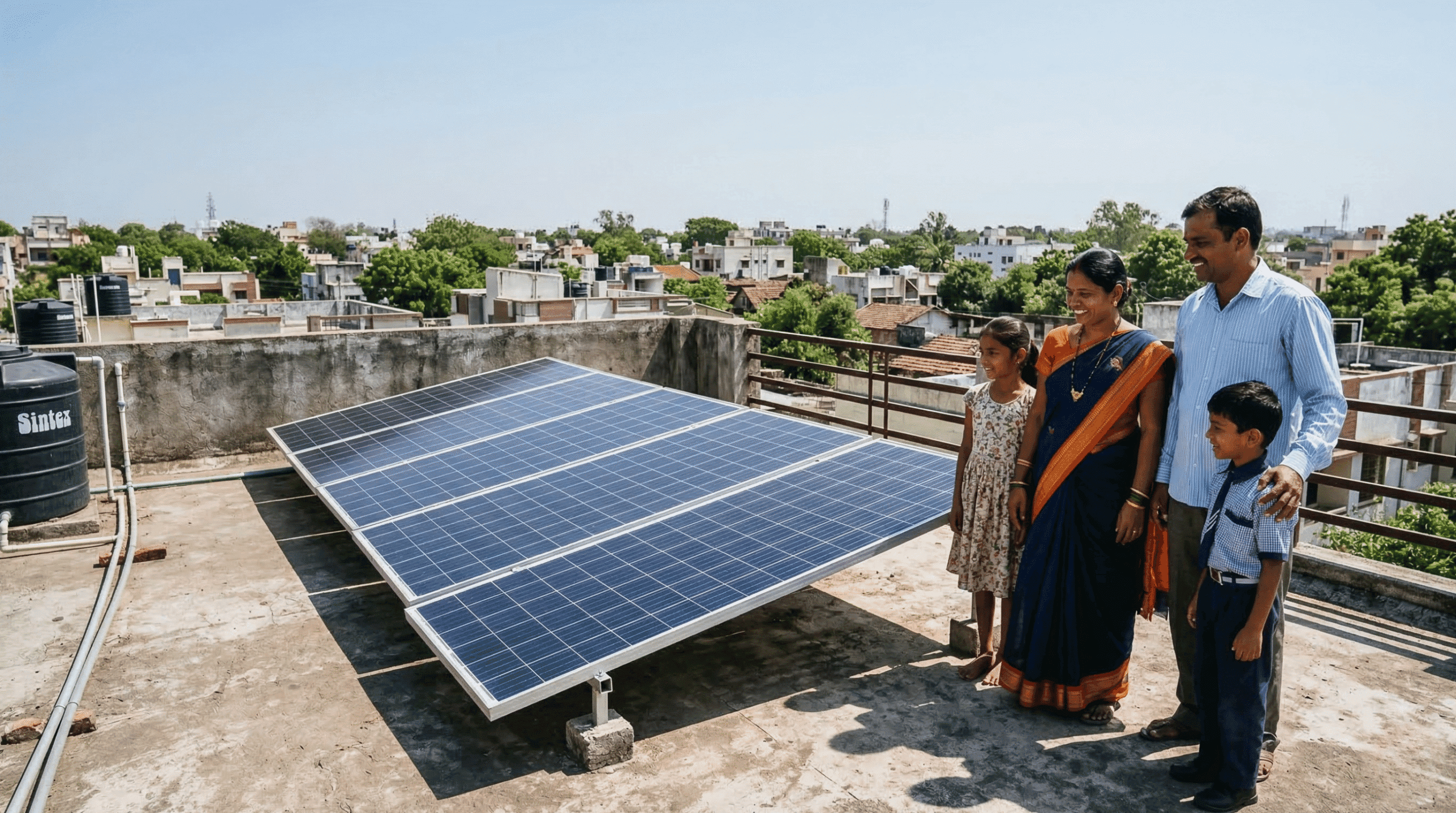
Let me paint a picture of our roof. It is a flat slab of concrete baking at 45 degrees Celsius.
We wanted to install a 3kW system using the state’s financial backing. The paperwork alone weighed enough to anchor a small boat.
I called an agent affiliated with MEDA. MEDA is the Maharashtra Energy Development Agency. He laughed at my timeline.
Getting approved for the Solar yojana maharashtra takes grit. It requires patience. And it demands a flawless paper trail.
You cannot just buy panels off Amazon and ask the government for cash. The system rejects outsiders. You must use empanelled vendors.
These vendors are strictly registered with Mahavitaran (MSEDCL). They know the local grid engineers. They know which forms get stamped and which get tossed in the trash.
Decoding the National Portal vs. State Reality
The confusion starts at the login screen. You hear about PM Surya Ghar. You hear about state-level boosts.
Which one do you actually use? We stared at the National Portal for Rooftop Solar for hours. The interface crashed twice.
Applying for the Solar yojana maharashtra means feeding the machine exactly what it wants. You need your latest MSEDCL electricity bill. You need an active Aadhaar card linked to your phone.
We uploaded a blurry photo of our 7/12 utara (land record). The system kicked it back immediately. Rejection stings.
We scanned it again. High resolution this time. The portal finally accepted our digital offering.
Hardware Headaches and DCR Mandates
You cannot slap any cheap glass on your roof. The government is entirely rigid about this.
To get the subsidy, you must use DCR panels. DCR stands for Domestic Content Requirement.
This means the solar cells and modules must be manufactured inside India. You cannot import cheap Chinese equipment. The Solar yojana maharashtra enforces this strictly.
We looked at Waaree Energies and Vikram Solar. Both are solid Indian brands. Both appeared on the ALMM (Approved List of Models and Manufacturers).
The vendor gave us a quote. A 3kW system with Monocrystalline PERC panels. These perform better in the blistering Wardha heat compared to older polycrystalline models.
Will Your Roof Survive the Solar yojana maharashtra Application?
Then came the structural audit. A guy named Rajesh showed up with a clipboard. He stomped around our terrace.
He was checking the load-bearing capacity of the concrete. Solar panels are heavy. The mounting structures are even heavier.
Wardha gets brutal wind speeds during the pre-monsoon squalls. If the panels fly off, they become glass guillotines.
Rajesh approved our roof. But he insisted on heavy-duty Hot Dip Galvanized (HDG) iron structures.
The Solar yojana maharashtra guidelines mandate specific wind-load tolerances. You cannot cut corners here. The inspector will catch it.
The Engineering Truth: What Actually Goes on Your Roof
Delivery day arrived. A dusty truck backed into our narrow lane. Workers started hoisting heavy glass up three flights of stairs.
I watched them assemble the skeleton. They used J-bolts to secure the iron base. They poured fresh concrete pedestals directly onto the terrace.
This takes days to cure. We waited. The sun kept beating down.
They finally mounted the Waaree panels. Facing true South. Angled perfectly at 21 degrees to catch the maximum Maharashtrian sun.
The wiring is a separate nightmare. You need UV-protected DC cables. Normal wires degrade and crack under the intense UV radiation.
The vendor installed a Solis string inverter on a shaded wall downstairs. The inverter is the brain. It turns raw sunshine into usable AC current for the fridge.
But we were not done. Not even close. We needed to protect the system.
They drove a thick copper rod three meters into the dry Wardha dirt. This is chemical earthing. A lightning arrester went up on the highest point of the roof.
The Solar yojana maharashtra requires triple earthing. One for the panels. One for the inverter. One for the lightning arrester.
Do not skip this. A single lightning strike will fry two lakh rupees worth of electronics instantly.
The MSEDCL Labyrinth: Net Metering Purgatory
Your panels are producing power. But you cannot use it legally yet.
You need a net meter. This is where the Solar yojana maharashtra process violently stalls.
The local Mahavitaran office is a fortress of files. We submitted the A1 form. We waited two weeks.
Nothing happened. I visited the sub-division office. The junior engineer was busy.
He told me the meters were out of stock. A classic delay tactic.
We held our ground. We cited the official MNRE timelines. You must assert yourself in these offices.
Forms, Fees, and Friction
We paid the testing fee. We carried our approved bi-directional meter to the testing lab in Nagpur.
The lab technician tested it for calibration. They sealed it with wire and a tiny lead stamp.
We brought it back to Wardha. The local lineman finally showed up. He killed the power to our street.
He ripped out the old spinning-disk meter. He wired in the new digital net meter.
This box measures what you pull from the grid. And it measures what you push back into the grid.
This is the entire point of the Solar yojana maharashtra. Making the meter spin backward. Or at least, making the numbers drop.
The Final Audit: Did the Meters Spin Backwards?
The lineman threw the massive changeover switch. A green LED blinked on the inverter.
We ran inside. The air conditioner was on. The fridge was humming.
I ran back outside. The net meter showed a negative sign. We were exporting power.
We were feeding electricity back into the Wardha grid. It felt surreal. The sun was paying our bills.
But the financial part of the Solar yojana maharashtra was still pending. We had paid the vendor his portion. Now we needed the government to pay theirs.
The vendor uploaded the joint commissioning report. He uploaded photos of me standing next to the panels.
This is a mandatory step. They need photographic proof of the homeowner.
The application moved to the state nodal officer. It sat there for twenty days. We checked the portal obsessively.
Finally, the status turned green. The subsidy amount hit my bank account a week later.
Let’s talk real numbers. The total cost was roughly ₹1,80,000 for the 3kW system.
The subsidy slashed a massive chunk off that price. We ended up paying around ₹1,02,000 out of pocket.
Our monthly bill dropped from ₹8,400 to roughly ₹350. The ROI is incredibly fast. We will recover our money in under two years.
For more technical data on grid tie policies, check the Official MNRE Portal. You can also read specific utility case studies in this Times of India Energy Report.
7 Secrets Behind the 1st Solar Village in India: A Staggering Success Story
But this requires maintenance. Dust is the enemy.
Wardha is dusty. A thick layer of dirt on the panels kills efficiency by 15%.
I have to climb up there every Sunday morning. I use a soft wiper and a bucket of water.
You cannot use hard water. It leaves calcium stains on the glass. Those stains block the sun permanently.
I buy distilled water from a local battery shop. It is annoying. But it keeps the power flowing.
You must monitor the inverter app daily. It connects via Wi-Fi.
Last month, the graph dipped randomly on a sunny Tuesday. I checked the roof. A massive crow had dropped a piece of garbage directly on a solar cell.
Even a small shadow shuts down the entire string of panels. I cleaned it off. The graph shot back up.
You become a slave to the weather app. You cheer for clear skies. You curse the clouds.
Is the entire brutal process worth the agony? Absolutely.
The grid is failing everywhere. Prices are only going up. You need to control your own power supply.
But it will test your patience. You will fight with bureaucrats. You will sweat on hot roofs.
The paperwork will drain your soul. Are you ready to fight the grid?