The rental Maruti Suzuki Swift was choking on the thick, white dust of the Mehsana highway. My cotton shirt clung to my back like a second, incredibly uncomfortable skin. It was late May in Gujarat. The 45-degree heat felt like a physical weight pressing down on my chest, threatening to crack my ribs.
I hadn’t driven three hours out of Ahmedabad just to suffer in the baking sun. I came looking for the 1st solar village in india.
A place where the electricity bills are reportedly negative. Yes. Negative.
I wanted to see if the government’s massive 65-crore rupee project was a genuine triumph or just a clever trick of accounting. I pulled into the dirt driveway of a local farmer named Dahyabhai. His house sat in the shadow of the ancient Sun Temple, but its roof caught my eye immediately.
Sleek, blue-black silicon panels baked silently in the brutal afternoon heat. A smart meter hummed quietly near his front door.
“Zero rupees,” Dahyabhai told me, holding up a crinkled piece of paper from the local distribution company. “Every single day. We pay nothing.”
And that is when I realized this wasn’t a rural gimmick. This was a completely functional, aggressive rewiring of an entire community’s survival mechanism.
Why the 1st solar village in india Is a Financial Miracle
Nobody living in Modhera is wealthy. Most of the 1,400 households here survive on dairy farming, small-scale agriculture, or selling trinkets to tourists visiting the local ruins. Every rupee is fought for.
Before the silicon panels arrived, powering a home here felt like bleeding cash through a copper wire. A typical family would burn through 1,500 to 2,000 rupees a month just to keep an ancient refrigerator running and a few ceiling fans spinning.
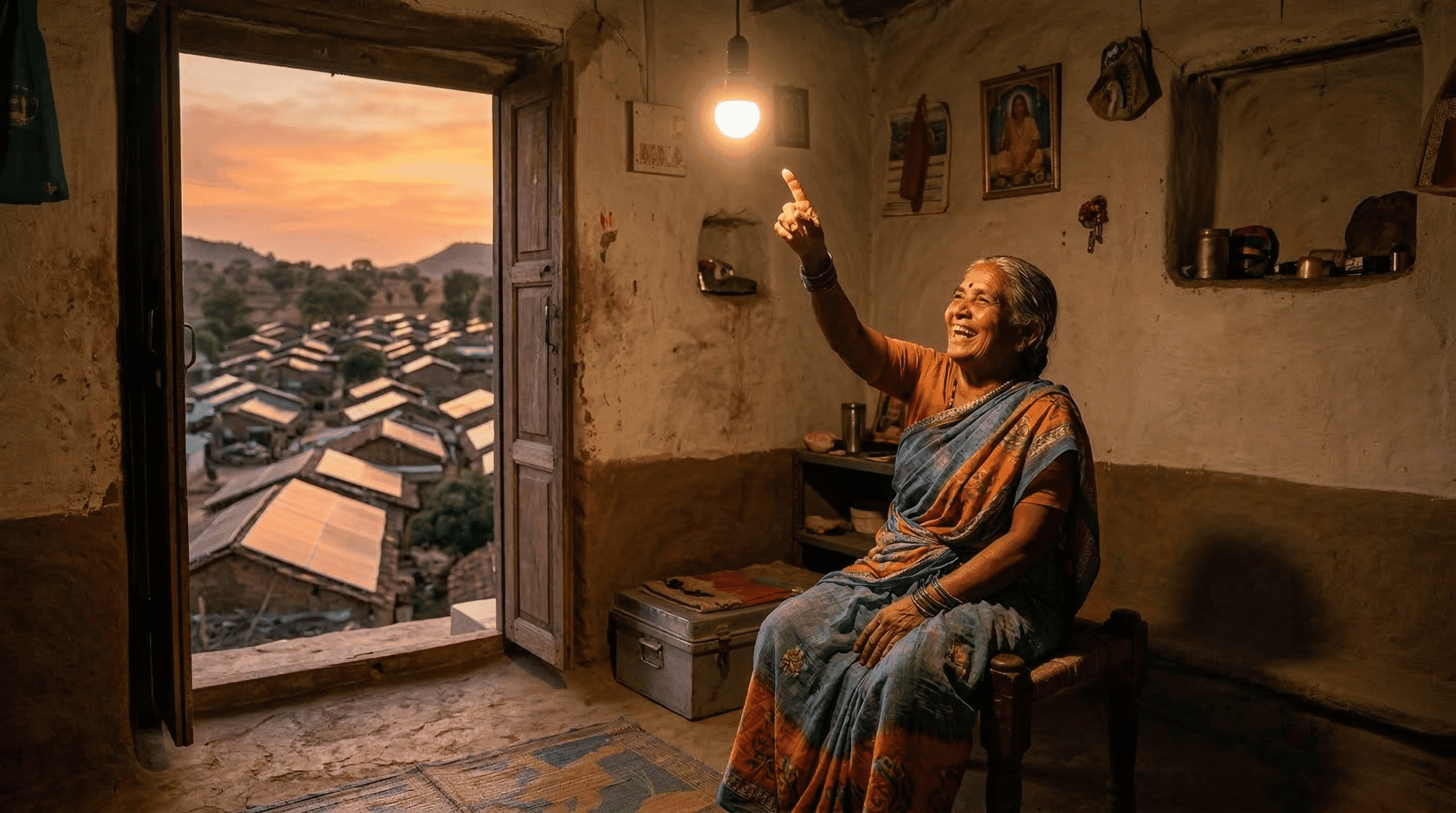
For a widow like Gadvi Kailashben, who scratches a living from a tiny plot of agricultural land, that monthly bill was a suffocating collar. She used to limit her electricity use to the barest minimum. Now, she runs a washing machine and an electric cooker without a second thought.
How did this happen? The Ministry of New and Renewable Energy (MNRE), alongside the state government, split a massive $9.7 million bill. They decided to build a 6-megawatt ground-mounted plant in nearby Sujjanpura.
But they didn’t stop there. They bolted 1-kilowatt rooftop systems onto 1,300 individual homes.
The result is staggering. The panels generate way more power than the villagers can actually consume during daylight hours. The surplus gets shoved forcefully back into the main grid.
Engineering the 1st solar village in india for 24/7 Power
Generating power under a blinding sun is the easy part. Storing it is where things usually fall apart.
If a town relies purely on the sun, the lights go out the second dusk hits. But Modhera does not go dark.
The secret weapon sits a few kilometers away from the residential streets. It is a massive 15 MWh Battery Energy Storage System (BESS). It looks like a series of heavy shipping containers dropped into a dusty field.
When the sun drops behind the horizon, this massive battery pack kicks in instantly. It feeds the entire population of Modhera throughout the night.
To manage this complex dance of electrons, the engineers brought in heavy corporate artillery. Mahindra Susten handled the enormous engineering and procurement contract. They integrated a highly advanced GreenPowerMonitor (GPM) system to track every single watt.
Inside those containers, FIMER power conversion systems work continuously. They juggle the load perfectly. If the broader grid collapses, the local battery system isolates itself and keeps the village running without missing a beat.
The Ancient Core of the 1st solar village in india
You cannot talk about Modhera without talking about its past. The contrast here is thick enough to cut with a knife.
A thousand years ago, the Solanki dynasty decided this exact spot of land was sacred. They built the magnificent Modhera Sun Temple. It is a staggering architectural marvel made of intricately carved sandstone, featuring the famous Surya Kund stepwell.
They built it to worship the sun. Today, the ancestors of those builders are surviving off that very same star.
The temple itself is now fully integrated into the modern grid. A 50-kilowatt solar parking infrastructure sits right outside the historic gates. Tourists can plug their modern electric vehicles into chargers powered by the blazing heat above them.
When the sun finally sets, a spectacular 3D light show illuminates the ancient sandstone pillars. The entire spectacle runs entirely on battery-stored sunshine.
It is a beautiful irony. The ancient world and the bleeding-edge modern world, totally dependent on the exact same celestial body.
The Hidden Burdens of the 1st solar village in india
Is this setup absolutely flawless? Absolutely not.
Technology is fragile, especially in an unforgiving climate. The dust in the Mehsana district is aggressive, fine, and relentless. It coats everything in a thick brown film within hours.
If you leave a silicon panel covered in dust, its efficiency plummets drastically. Someone has to climb up onto those 1,300 roofs and scrub the glass. It is hard, physical, punishing labor.
Then there is the sheer financial weight of the infrastructure. Dropping $9.7 million on a single settlement of 1,400 households is a massive capital expenditure.
Scaling this exact model to India’s 600,000 other villages would require a budget that borders on the astronomical. The heavy lithium-ion batteries degrading in the sweltering heat will eventually need replacing.
Who pays for the fresh battery cells in a decade? That detail remains distinctly murky.
Yet, the social payout is impossible to ignore. Women in Modhera used to spend hours gathering firewood, inhaling toxic smoke just to boil rice. Today, they push a button on a clean, silent induction stove.
Lung infections are dropping. Disposable income is rising.
For those wanting to dig deeper into the global implications, UN News recently documented how this specific project aligns with international climate goals. It serves as a stark proof of concept for the rest of the developing world.
7 Truths About 5kW Solar System Price in India With Subsidy: Massive Savings
Even with the maintenance headaches, the psychological shift in Modhera is permanent. They are no longer victims of unpredictable tariff hikes from a faceless utility company.
They own their power. They own their future.
So, as I sat in my rental car, cranking the AC and watching Dahyabhai wave goodbye, a singular thought hit me. We have the technology to sever our reliance on fossil fuels right now.
The hardware exists. The money is there. So, what exactly is stopping your town from pulling the plug on the grid?