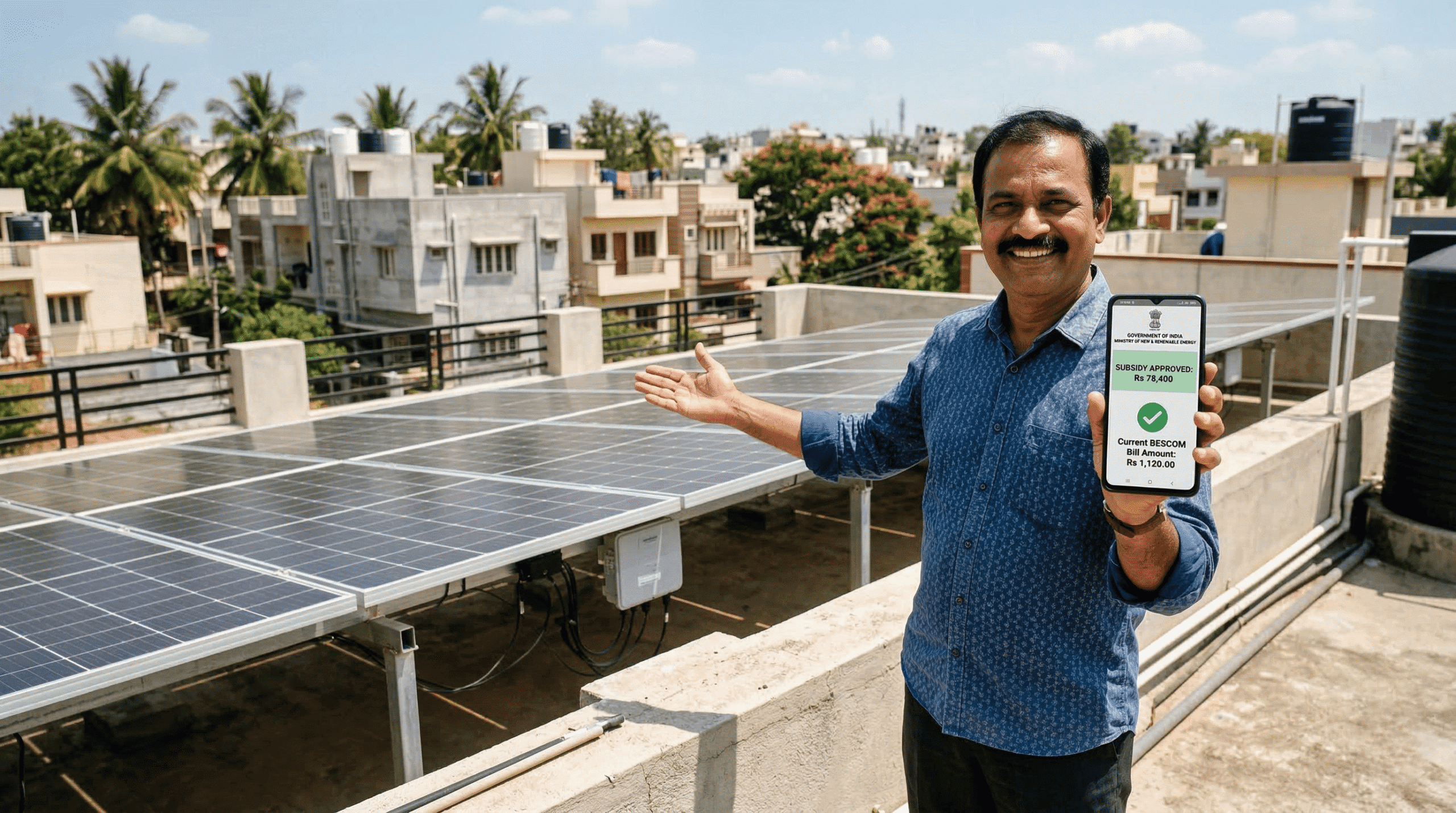
Last month, a homeowner in Jodhpur watched their rooftop investment melt into a bureaucratic nightmare. They expected free electricity and a fat government check. Instead, they received a rejected application and a ₹3,20,000 hole in their bank account. Why? Because they entirely misunderstood the strict mechanics of the 5kw solar system price in india with subsidy.
Most buyers walk into the renewable energy market blind. They trust glossy brochures from aggressive salespeople. A fatal mistake.
The reality of state-sponsored energy rebates is wrapped in heavy red tape. Navigating the PM Surya Ghar Muft Bijli Yojana requires precision, patience, and a flawless understanding of domestic content regulations. If you buy the wrong panels, you get zero financial support.
Let’s dissect the actual financial burden. We will expose the hidden fees, the specific hardware requirements, and the ruthless approval process that dictates your final invoice.
The Brutal Reality of the 5kw Solar System Price in India With Subsidy
Many consumers assume the government hands out blank checks for green energy. That is a dangerous myth. The central administration heavily regulates the exact payout structures based on precise capacity limits.
Under current national frameworks, the financial relief caps out strictly at three kilowatts for residential setups. You receive approximately ₹30,000 for the first kilowatt. The second kilowatt earns another ₹30,000.
The third kilowatt secures just ₹18,000. Anything beyond that generates zero additional central relief. So, when evaluating the 5kw solar system price in india with subsidy, your maximum baseline rebate from New Delhi sits firmly at ₹78,000.
You must absorb the entire commercial cost for the remaining two kilowatts. But this does not mean the investment is a poor choice. It just requires aggressive math.
Breaking Down the Bare Hardware Costs
What actually makes up that terrifying initial quotation? It is not just shiny glass and metal. You are purchasing a miniature power plant.
A high-grade five-kilowatt setup demands ten to twelve monocrystalline PERC modules. These silicon slabs act as the beating engine of your array. Quality panels from approved domestic manufacturers currently command a premium.
Then comes the inverter. This heavy box acts as the brain of your operation, converting raw DC voltage into usable household current. Buying a cheap inverter is like installing a lawnmower engine inside a sports car.
You must also account for the Balance of System (BoS). This includes hot-dip galvanized iron mounting structures, heavy-duty DC cables, earthing pits, and lightning arresters. Cutting corners on wiring acts like a slow-burning fuse waiting to destroy your property.
Navigating the Subsidized Maze: State vs. Central Rules
Buyers often stop their calculations after subtracting the central ₹78,000 rebate. And they leave money on the table. Several regional administrations offer aggressive secondary incentives to push adoption.
In Uttar Pradesh, residents can extract an extra ₹30,000 from the state government. This pushes their total relief past the one-lakh mark. Haryana and Rajasthan also periodically inject localized funds to sweeten the deal.
To find the true 5kw solar system price in india with subsidy in your specific PIN code, you must manually cross-reference local DISCOM policies.
7 Polycrystalline Solar Panel Secrets Nobody Tells You (Insane Value)
The Jodhpur Disaster: A Cautionary Anecdote
I recently inspected a residential project near the Mehrangarh Fort in Jodhpur. The homeowner, a local spice merchant, thought he cracked the system. He found a grey-market vendor offering imported modules at a ridiculous discount.
He wired the cash immediately. He assumed the paperwork for the central rebate would slide through the system. But he ignored the Ministry of New and Renewable Energy’s strict DCR mandate.
The Domestic Content Requirement strictly dictates that only cells and modules manufactured inside Indian borders qualify for government cash. When the Jodhpur Vidyut Vitran Nigam Limited (JDVVNL) inspector arrived, the application died on the spot. The merchant absorbed the entire commercial cost, bleeding cash like a severed artery.
The ALMM Mandate: Your Roster of Approved Brands
You cannot just buy a random branded box off the internet. The government maintains a tightly guarded registry known as the Approved List of Models and Manufacturers.
If your chosen equipment is absent from this list, your subsidy application vanishes into the void. Brands like Waaree, Vikram, and Tata Power dominate this registry. You must demand the exact model numbers from your installer before signing a contract.
Always cross-reference your quote against the official MNRE ALMM database. A single digit mismatch on the invoice can derail your entire financial plan.
What is the True 5kw Solar System Price in India With Subsidy?
Let’s rip away the marketing fluff and look at the raw mathematics. A premium on-grid setup utilizing ALMM-approved monocrystalline panels will gross between ₹3,00,000 and ₹3,30,000.
This covers standard installation, transport, and five years of mandatory maintenance from an empaneled vendor. Once the system is live and verified, the central government drops ₹78,000 directly into your bank account.
Your net out-of-pocket expense settles between ₹2,22,000 and ₹2,52,000. If your state offers additional funds, that floor drops even lower.
Net Metering: The Invisible Bureaucratic Hurdle
Bolting the hardware to your roof is only the first phase of the war. The real battle happens inside the local utility office. You need a bi-directional meter to track your exported power.
The net meter spins backward when your panels push excess electrons into the neighborhood grid. This mechanism is the only way to genuinely zero out your monthly bill. But state electricity boards despise losing paying customers.
They drag their feet. Applications sit on dusty desks for weeks. You must relentless follow up with your local linesman and sub-divisional officer to force the installation through.
The Illusion of Battery Storage
Many buyers demand massive battery banks to survive regional blackouts. They want total independence from the grid. A noble desire.
But adding lithium-ion storage violently distorts the financial math. The government entirely refuses to subsidize off-grid or hybrid systems. The PM Surya Ghar scheme only covers grid-tied setups.
A high-capacity hybrid inverter and a reliable lithium battery pack will instantly add ₹1,50,000 to your invoice. If you calculate the 5kw solar system price in india with subsidy for a hybrid setup, you will quickly realize the return on investment stretches from four years to nearly nine.
Registration on the National Portal
You cannot bypass the digital gatekeepers. Every single application must originate on the official.
You start by logging in with your exact consumer number tied to your electricity bill. The name on the utility bill must perfectly match the name on the bank account receiving the funds. A slight spelling error will trigger an automated rejection.
After securing initial feasibility approval from the DISCOM, you select a registered vendor. Do not pay cash to unregistered local electricians. Only empaneled agencies possess the clearance to upload the final commissioning reports.
Inspecting the Roof Real Estate
A massive solar array requires vast, unshaded territory. You need roughly 400 to 500 square feet of clean rooftop space.
Shadows act like poison to solar generation. A single water tank shadow creeping across one panel can drag down the output of the entire string. Your vendor must conduct a rigorous shadow analysis using dedicated software.
If you live in a multi-story apartment complex, securing this space becomes a brutal political fight with your Resident Welfare Association. You must secure explicit written permission before spending a single rupee.
The Myth of Zero Maintenance
Salesmen love to claim that rooftop arrays run themselves. This is a highly profitable lie. Dust acts like a heavy wool blanket smothering your energy production.
In arid regions like Rajasthan or heavily polluted urban centers like Delhi, a thick layer of grime can slash efficiency by twenty percent in a single week. You must physically scrub the glass.
And you cannot use hard groundwater. Calcium deposits will bake into the glass under the intense summer heat, permanently scarring the modules. You need a dedicated soft-water line and a telescopic wiper.
Understanding Panel Degradation
Solar modules do not last forever. They bleed efficiency every single year.
Most tier-one manufacturers guarantee a linear performance drop over twenty-five years. By year ten, your five-kilowatt system might only behave like a four-kilowatt system.
You must factor this decay into your long-term payback calculations. If your household energy consumption aggressively rises because you bought three new air conditioners, your aging array will fail to cover the load.
Navigating Inverter Warranties and Failures
The inverter is the weakest physical link in the entire chain. While panels easily survive two decades of abuse, the inverter endures brutal thermal stress.
It handles massive voltage spikes and aggressive heat buildup. Most standard string inverters carry a basic five-year warranty. You will almost certainly need to replace this component at least once during the lifetime of the system.
When mapping out the 5kw solar system price in india with subsidy, smart buyers stash away an emergency fund. Replacing a burned-out unit in year seven will easily cost ₹45,000.
The Hidden Threat of Grid Failures
Here is the darkest secret of standard grid-tied setups. When the neighborhood power grid goes black, your panels instantly shut down.
Even if the midday sun is screaming down on your roof, your home will sit in total darkness. Why? It is an anti-islanding safety protocol.
If your panels continued pushing live current into the grid during a blackout, they would instantly electrocute the linemen trying to repair the broken transformers. Unless you purchase a highly expensive hybrid system, you remain entirely at the mercy of the state’s infrastructure.
Financial Engineering and Solar Loans
Not everyone has two lakh rupees sitting idle in a checking account. The financial sector has aggressively stepped in to fill the gap.
Major nationalized banks now offer dedicated rooftop solar loans with highly suppressed interest rates. They treat the installed equipment as the primary collateral.
If you structure the financing correctly, your monthly EMI payment to the bank will exactly match the amount of money you used to pay the utility company. You essentially swap a permanent electricity bill for a temporary equipment loan.
Verifying the Commissioning Report
The final step in the subsidy journey is the most agonizing. Your vendor must upload a flawless commissioning certificate to the national portal.
This document proves that the bi-directional meter is active, the ALMM modules are authentic, and the system complies with all safety regulations. The DISCOM then conducts a physical inspection.
If the earthing pit is too shallow or the lightning arrester is improperly mounted, the inspector will deny the clearance. Your subsidy money will remain locked in a bureaucratic vault until the contractor physically fixes the defects.
Are You Ready for the Grid?
The financial mechanics of securing cheap energy are intentionally complex. The government actively filters out lazy consumers who refuse to read the technical guidelines.
You possess the exact framework to dissect vendor quotes, bypass grey-market scams, and force the utility company to honor your net metering rights. The numbers heavily favor the aggressive buyer.
But as electricity tariffs aggressively climb across the subcontinent, waiting on the sidelines burns cash every single month. The subsidies are strictly capped, and government budgets eventually dry up. Will you secure your piece of the grid, or will you continue renting your power from a monopoly?