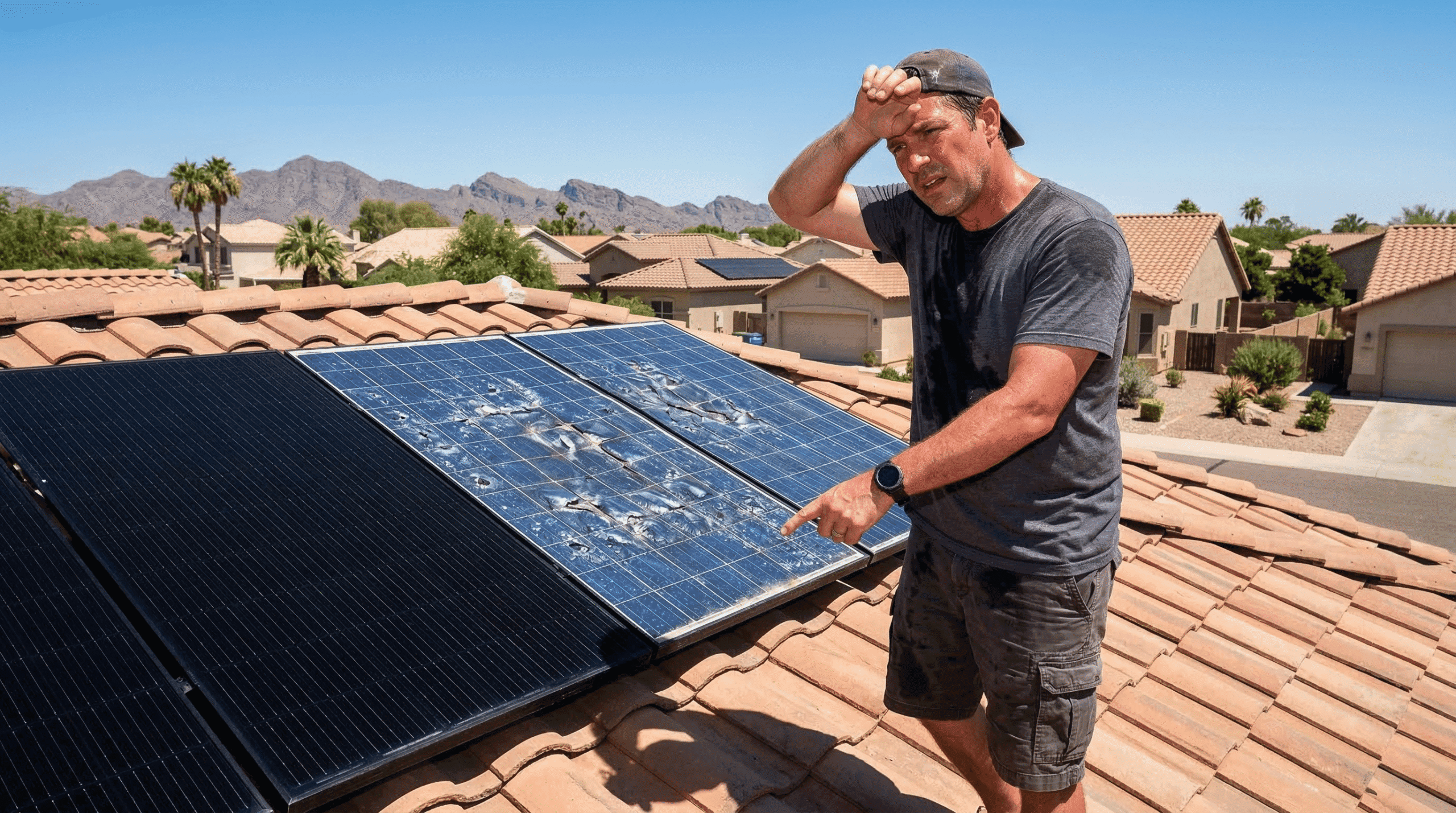
The mercury hit 118 degrees in Phoenix last July. My air conditioning unit coughed, sputtered, and died entirely.
Total blackout.
Sweat instantly glued my shirt to my back. That sweltering afternoon forced me to confront the reality of monocrystalline vs polycrystalline solar panels on my own roof. I had chosen the cheaper blue squares five years ago to save a few bucks.
Big mistake.
They cooked like cracked eggs on black asphalt. Their voltage output plummeted precisely when my family needed cold air the most. I grabbed my multimeter and climbed the scorching ladder to test the array.
The readings were dismal.
This failure sent me down a rabbit hole of solar physics, manufacturing flaws, and brutal financial math. You deserve the unvarnished facts before you sign a 25-year contract with a local installer.
The Great Bake-Off: Monocrystalline vs Polycrystalline Solar Panels in Extreme Heat
Heat destroys electronics. Solar technology is no exception to this cruel rule of thermodynamics.
When panels get hot, they lose efficiency. We measure this performance drop using a metric called the temperature coefficient.
And the truth hurts.
Poly cells handle extreme temperatures like a fragile glass jaw. For every degree above 25°C (77°F), a standard polycrystalline array loses a massive chunk of its generating power.
Mono cells fight back harder. Their single-crystal structure allows them to maintain voltage even when the ambient air feels like a blast furnace.
If you live in Arizona, Texas, or Florida, ignoring the temperature coefficient is financial suicide. You will bleed cash every August.
Why Monocrystalline vs Polycrystalline Solar Panels Matters for Your Wallet
Let’s talk about the initial sting. Upfront costs always dictate the conversation when contractors visit your kitchen table.
Poly arrays look incredibly cheap on paper. Installers push them hard because the margins are thick and the raw materials cost next to nothing.
But cheap silicon carries a hidden tax.
You need significantly more roof space to generate the same wattage as a mono array. If your roof has tricky angles or massive dormers, poly panels simply will not fit.
I learned this the hard way. My installer had to cram the blue panels around plumbing vents, leading to severe shading issues.
5 Insane 2kW Solar Panel Price Secrets (That Save You Lakhs) in 2026
The Silicon Bloodline: How Factories Build the Cells
To understand the price gap, you must look at the dirt. Silicon is just purified sand.
But how we treat that sand changes everything.
Making a mono cell requires the Czochralski method. It sounds like a Soviet submarine class. It actually involves pulling a single, massive silicon seed crystal out of a vat of molten rock.
Pure.
Unbroken.
This flawless structure gives electrons a smooth highway to travel on. They slide through the material without bumping into microscopic walls.
Poly manufacturing is entirely different. Factories just pour melted silicon into a square mold.
Like baking cheap brownies in a rush.
The liquid cools fast, forming a jagged collision of multiple crystals fighting for dominance. Electrons get trapped in these borders, killing efficiency.
Aesthetically Speaking: The Black Tuxedo vs The Blue Jeans
Looks matter when you bolt hardware to the front of your house for three decades. Homeowners associations will absolutely notice the difference.
Mono arrays wear a sharp, pitch-black tuxedo. They blend seamlessly into dark asphalt shingles.
They look expensive.
Poly arrays sport an undeniable, shattered blue camouflage pattern. The anti-reflective coating interacts with the chaotic crystal borders to create a shimmering, metallic blue hue.
Some people like the industrial look. Most upscale neighborhoods hate it.
If curb appeal factors into your property value, the black panels win without a fight.
Brand Warfare in the Silicon Trenches
Not all panels roll off the assembly line equal. You have to look at the nameplates bolted to the aluminum frames.
I recently tested the SunPower Maxeon 6 series against a budget-tier Trina Solar Vertex array. The difference was staggering.
SunPower uses premium n-type monocrystalline silicon. They back it with a ruthless 40-year warranty.
Trina pushes massive volumes of cheaper, large-format poly and standard mono variations. They work fine in ideal conditions.
But nature is rarely ideal.
Degradation is the Silent Thief
Every solar panel rots a little bit each year. The sun slowly degrades the silicon bonds through relentless ultraviolet punishment.
We call this the annual degradation rate.
Premium mono panels typically lose about 0.25% of their capacity annually. They remain highly productive long after your kids leave for college.
Poly panels degrade faster. Expect to lose 0.5% or more every single year.
Compound that loss over twenty years. You are losing thousands of kilowatt-hours to standard decay.
The Space Race on Your Shingles
Efficiency ratings dictate exactly how much power you can squeeze out of a standard 60-cell footprint.
Mono technology currently hovers between 20% and 23% efficiency. Researchers keep pushing that boundary higher in the lab.
Poly technology struggles to break the 17% ceiling. The physical limitations of the fractured silicon cannot be ignored.
This means a 400-watt mono panel takes up the exact same physical space as a 320-watt poly panel.
Space is a premium commodity.
If you want to offset an electric vehicle charger, you need every single watt you can extract from your roof.
NEM 3.0 and the Math of Survival
California recently gutted its solar compensation rules with the NEM 3.0 mandate. The utility companies stopped paying retail rates for excess solar production.
Other states are quickly copying this hostile playbook.
To survive in a post-NEM 3.0 world, you must pair your panels with a localized battery system like the Tesla Powerwall 3.
Batteries require massive, sudden bursts of charging power during peak sunlight hours.
Poly panels struggle to fill heavy batteries quickly during short winter days. Mono panels suck in enough power to keep your home running off-grid through the night.
The Hidden Costs of Installation Weight
Heavy panels break backs. They also stress older roof trusses.
Because poly systems require more panels to reach the target kilowatt rating, you add significant dead weight to your home’s structural framing.
More panels mean more aluminum racking.
More racking means more penetrations drilled directly into your waterproof membrane.
Every hole drilled is a potential water leak waiting to ruin your drywall during a spring storm.
Efficiency directly reduces roof penetrations. Fewer panels equal less risk.
The Shading Death Spiral
Trees grow. Chimneys cast long shadows at 3:00 PM.
Standard poly strings handle shade terribly. If a single leaf covers a corner of one panel, the entire string’s output can crash by half.
The bypass diodes overheat trying to reroute the current.
Modern mono panels often integrate advanced split-cell architecture. They cut the cells in half.
If the bottom half of the panel sits in darkness, the top half keeps pumping electricity into your breaker box.
It acts like two independent engines running side by side.
End of Life: The Dirty Secret of Clean Energy
Nothing lasts forever. Eventually, these glass rectangles will end up in a landfill or a recycling shredder.
Recycling facilities struggle with both types of silicon.
However, mono panels contain higher-grade, purer silicon. This makes recovering the raw materials slightly more economically viable for scrap companies.
Poly panels contain too many impurities. They often get crushed into raw glass aggregate for road construction.
We are dumping millions of tons of dead panels into the earth.
Purchasing higher-efficiency equipment means generating less physical waste per megawatt over your lifetime.
Making the Hard Choice on the Roof
I eventually called a crew to rip the old blue panels off my house in Phoenix.
I ate a massive financial loss.
We bolted down a sleek, black mono array paired with microinverters. The next time the heatwave hit 115 degrees, the system barely flinched.
The AC kept humming. My family stayed cool.
The initial price tag was painful. The peace of mind was entirely worth the sting.
So, what are you going to do when your installer hands you that glossy brochure with two wildly different price tags?