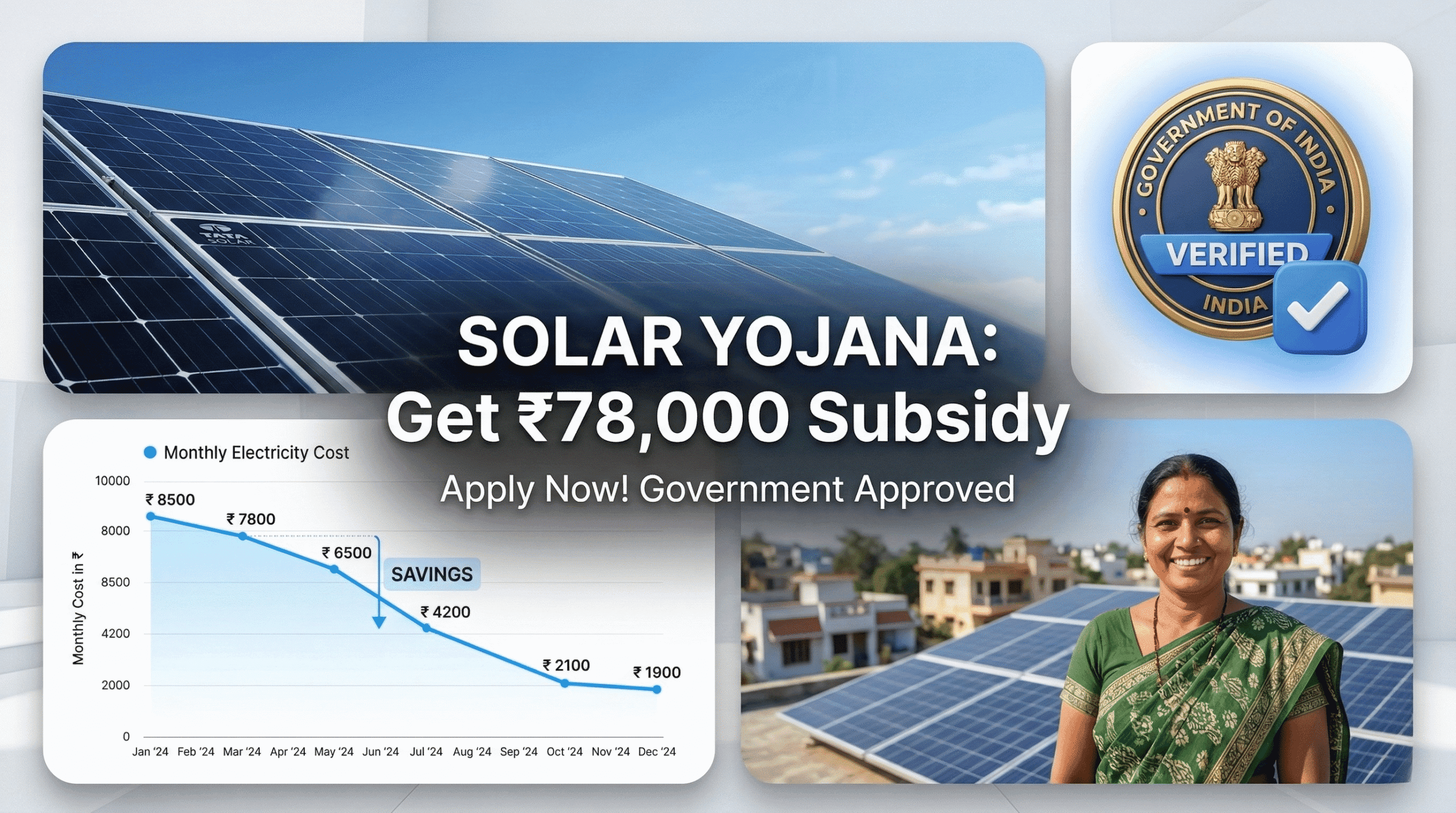
I watched my neighbors install massive glass plates on their roofs while I kept writing checks to the DISCOM every month. Last summer, my bill hit a record high of ₹4,500. That was the breaking point. I decided to find every loophole and benefit in the Solar panel sarkari yojana to see if it actually lived up to the hype.
Spoiler: It does. But only if you know how to navigate the paperwork.
Why My First Application for Solar Panel Sarkari Yojana Failed
Before we get into the wins, let’s talk about the mess. I initially tried to apply without checking the feeder capacity of my local grid. Big mistake.
The DISCOM rejected me in three days. I had to go back, talk to a local technician, and realize that the Solar panel sarkari yojana isn’t just a “plug and play” system; it’s a grid-matching game. Once I fixed my technical feasibility report, the subsidy started flowing.

1. The PM Surya Ghar Muft Bijli Yojana Blueprint
The big player in the Solar panel sarkari yojana world right now is the PM Surya Ghar Muft Bijli Yojana. Launched in February 2024, it aims to give 300 units of free power to 1 crore homes.
The math is simple. If you install a 3kW system, the government hands you a fixed subsidy of ₹78,000.
Subsidy Breakdown:
- 1kW System: You get ₹30,000.
- 2kW System: You get ₹60,000.
- 3kW and Above: You get a flat ₹78,000.
And the best part? Some states like Delhi or Uttar Pradesh add their own “top-up” subsidies. In UP, for instance, I’ve seen people grab an extra ₹30,000 on top of the central fund. That’s nearly ₹1 lakh off the total cost.
2. Eligibility: Do You Actually Qualify?
Most people think this Solar panel sarkari yojana is only for farmers or below-poverty-line families. That’s a myth.
If you own a roof and have a valid electricity connection, you’re in the running. But you need a clear title to the roof. I spent two weeks chasing down an old property tax receipt just to prove I owned the space. Don’t be like me. Have your “Proof of Ownership” ready before you hit the portal.
Quick Checklist:
- Indian Citizenship.
- A roof that isn’t shaded by a massive Peepal tree.
- A concrete roof (tin sheds often get rejected).
- No previous solar subsidies claimed.
3. The 1% Rule for Maximum Savings
When I installed my 3kW set, I realized that the Solar panel sarkari yojana works best when your generation matches about 90% of your usage.
Why? Because selling power back to the grid (Net Metering) pays you less than what you pay for power. You want to consume what you make. Use your AC during the day when the sun is blasting. Wash your clothes at noon. Shift your “heavy load” to the sun’s schedule.
4. Avoiding the “Cheap Vendor” Trap
The official portal (pmsuryaghar.gov.in) lists registered vendors. Stick to them.
I had a guy offer to do it for 20% less if I “went around” the portal. I said no. Why? Because the Solar panel sarkari yojana subsidy is paid directly to YOU (the consumer) via DBT (Direct Benefit Transfer). If you don’t use a registered vendor and get a commissioning certificate, that ₹78,000 check will never arrive.
And trust me, waiting for that money is stressful enough without wondering if your vendor is a ghost.
5. Financing Without Collateral
Don’t have ₹2 lakh sitting in the bank? Neither did I.
The government worked with 12 Public Sector Banks to offer collateral-free loans. The interest rate is capped at about 0.5% above the repo rate. Right now, that’s around 7%.
In my case, the EMI was roughly ₹1,300. But my electricity bill dropped from ₹4,000 to basically the fixed “meter charge” of ₹150. The system literally pays for its own loan.
Final Thoughts: Is It Worth the Hassle?
The paperwork for the Solar panel sarkari yojana can feel like dragging concrete uphill. But once that net meter starts spinning backward, it’s a beautiful sight.
So, are you going to keep paying for coal-fired power, or are you ready to let the sun pay your bills?
What’s stopping you from applying today? The roof space is already there—you might as well make it work for you.
PM Surya Ghar:Muft Bijli Yojana
9 Insane Mono vs Poly Solar Panels Tips (Indian Context) in 2026