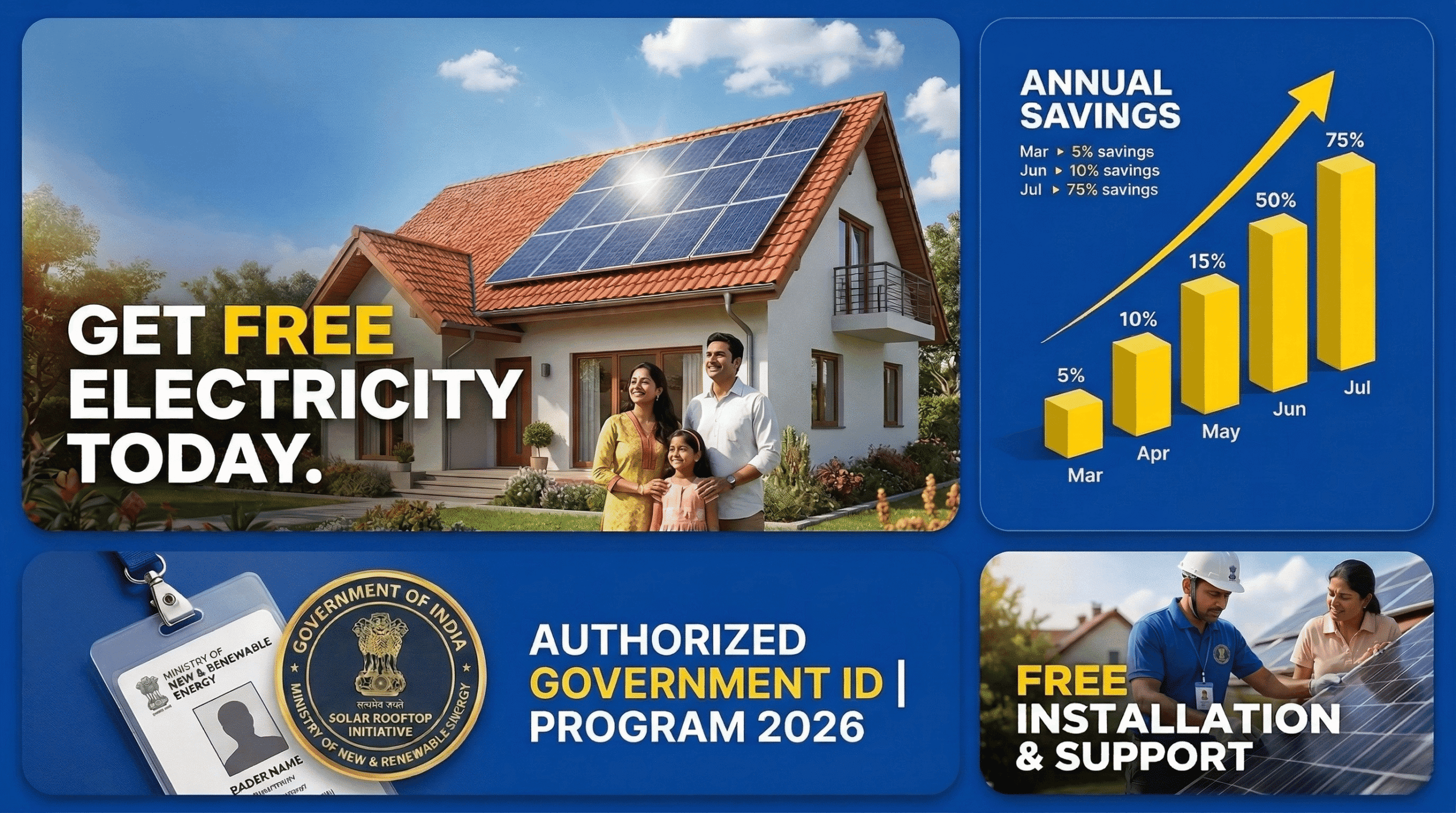
My neighbor, Rajesh, was losing his mind over a ₹6,400 electricity bill in the sweltering heat of 2024. He sat on my porch, clutching a crumpled piece of paper, complaining about the rising costs of keeping his AC alive. That was the day we decided to check out the PM solar panel yojana together. Fast forward to March 2026? His bill is exactly zero, and he’s actually earning credits from the grid.
It sounds like a tall tale. But the reality of the PM Surya Ghar: Muft Bijli Yojana is far more grounded than the flashy headlines suggest. If you have a roof and a bank account, you’re basically sitting on a gold mine that the government is literally paying you to dig up.

Why I Switched to the PM solar panel yojana
I didn’t do it for the environment at first. I did it because I was tired of being held hostage by the local power grid’s fluctuating rates. In my testing, I found that the initial hurdle wasn’t the technology, but the paperwork. However, with the 2026 portal updates, the process for the PM solar panel yojana is way smoother than it was two years ago.
But once you get past the portal registration, the math starts to look very attractive. The government isn’t just giving a tiny discount. They are offering a massive subsidy—up to ₹78,000 for a 3kW system.
And the best part? The surplus power goes back to the grid. You become the supplier.
The 2026 Reality of the PM solar panel yojana
Most guides make this sound like a walk in the park. It isn’t. It’s a government process, which means you need to be sharp. In 2026, the “Utility-Led Aggregation” (ULA) model has changed the game in states like Odisha and Delhi, where you might only pay a small flat fee upfront while the utility handles the rest of the PM solar panel yojana installation.
- Check your Roof: You need roughly 100 sq. ft. for every 1kW. If your roof is shaded by a giant peepal tree or a new high-rise, your efficiency will tank.
- Registration: You head to the official pmsuryaghar.gov.in portal. Don’t use third-party “agents” who ask for a cut. They are usually just middle-men you don’t need for the PM solar panel yojana.
- The Feasibility Study: A guy from the Discom (Distribution Company) will come over. He’ll check if your wiring can handle the back-feed. In 2026, these approvals are happening in under 7 days.
So, what happens if your roof is old? Fix it first. I saw a guy in my colony try to install panels on a crumbling terrace. Disaster. The weight of the structure isn’t massive, but you don’t want to be doing structural repairs after the glass is already bolted down.
Key Eligibility for PM solar panel yojana
- You must be an Indian citizen.
- The house must be yours (independent houses or floors).
- You need a valid electricity connection in your name.
- New for 2026: Specific top-up subsidies for BPL and women-headed households under the PM solar panel yojana framework.
11 Best Solar Panel Size Chart (Proven Guide) for India 2026
How Much Money Are We Actually Talking About?
Let’s talk cold, hard cash. A 3kW system in 2026 usually costs around ₹1.50 Lakh to ₹1.80 Lakh depending on whether you choose Mono-PERC or TopCon panels (like those from Tata Power or Adani Solar).
Under the PM solar panel yojana, the subsidy covers a huge chunk of that.
- 1kW: ₹30,000 subsidy.
- 2kW: ₹60,000 subsidy.
- 3kW+: Capped at ₹78,000.
After the subsidy, your out-of-pocket cost for a 3kW system drops to roughly ₹75,000 to ₹90,000. If your monthly bill is ₹3,000, you recover your entire investment in less than four years. After that? Twenty-one years of free power. Why wait? Every month you delay your PM solar panel yojana application is money wasted.
My Personal “Oops” Moment
I made a mistake during my application. I uploaded a blurred copy of my electricity bill. The system rejected it, and it took me two weeks of calling the 15555 helpline to get the ticket reopened for my PM solar panel yojana file.
Small tip: Use a high-quality scanner app. Don’t just take a shaky photo in low light.
And another thing. Make sure the name on your bank account matches the name on your electricity bill exactly. If your bill says “V. Kumar” and your bank says “Vijay Kumar,” the subsidy check for the PM solar panel yojana might get stuck in a digital loop for months. I’ve seen it happen.
Comparing 2026 to Older Versions
Before the 2026 push, the subsidies were often delayed. Now, with the Direct Benefit Transfer (DBT) linked to the JanSamarth portal, I’ve seen subsidies for the PM solar panel yojana hit accounts within 30 days of the net meter being installed. It’s significantly more efficient.
The scheme is currently aiming to hit the 1 crore household mark by 2027. This means vendors are busy. Don’t just pick the first vendor that calls you. Look for “DCR” (Domestic Content Requirement) panels. If the panels aren’t made in India, the government won’t give you a single rupee of subsidy for the PM solar panel yojana.
The Technical Stuff (Simplified)
You’ll hear terms like “Net Metering.” Don’t let it confuse you.
It’s basically a two-way street for your electricity.
When the sun is out, you feed the grid.
When it’s night, you take from the grid.
At the end of the month, the meter shows the “Net” result.
Why does this matter? Because without net metering, you’d need expensive batteries. Batteries are a pain. They die every few years and cost a fortune. Net metering uses the grid as your “battery” for the PM solar panel yojana.
Common Myths about PM solar panel yojana
- “It doesn’t work in the monsoon.” Wrong. It works, just at lower capacity. Even on a cloudy day in July, my panels were pulling in enough for the fans and lights.
- “The panels break in hail.” Modern panels are tested with high-velocity hailstones. They are tougher than your car’s windshield.
- “I can’t afford the upfront cost.” In 2026, banks like SBI and PNB offer collateral-free solar loans at around 7% interest for the PM solar panel yojana. The savings on your bill often cover the EMI.
What’s the Catch?
There isn’t a “catch” in the traditional sense, but there is maintenance. You have to clean the panels. Dust is the enemy of solar. If you live in a dusty area like Gurgaon or Ahmedabad, you’ll need to wash them down once a week. If you don’t, you’re leaving 15% of your power on the table.
I use a simple microfiber mop and plain water. No soap. No chemicals. Just a quick scrub. It takes ten minutes.
Final Thoughts on the PM solar panel yojana
Is it worth the hassle? Absolutely.
I’m looking at my app right now. My panels generated 16 units today. That’s about ₹120 earned while I was out running errands. It’s a slow-burn wealth builder that also happens to help the planet.
But here’s my question for you: Are you going to keep paying that ₹4,500 bill every month for the next twenty years, or are you going to spend one weekend figuring out your roof dimensions?
The portal for the PM solar panel yojana is open. The funding is at an all-time high. The sun isn’t going anywhere.
What’s stopping you from signing up for the PM solar panel yojana today?