I watched a business owner in Gujarat lose nearly ₹3,50,000 in tax savings last year because they missed a single “placed in service” deadline by three days. It was painful. They thought they had the 40% accelerated depreciation on solar panels locked in for the fiscal year, but a logistics snag at the Mundra port pushed the final grid connection into April.
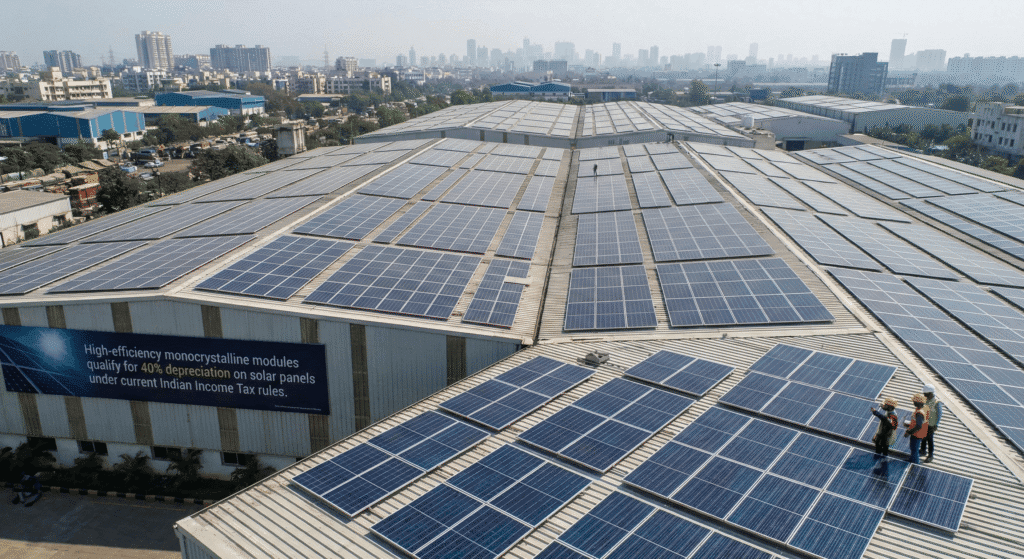
But here is the good news: the rules for depreciation on solar panels in India are still incredibly lucrative for those who know the math. Even though we’ve moved past the old 80% “accelerated” era, the current 40% Written Down Value (WDV) rate remains a massive tax shield for Indian MSMEs and large industries alike.
If you’re running a factory in Maharashtra or a cold storage unit in Haryana, that solar array isn’t just a green badge. It’s a financial weapon. But you have to know how to pull the lever.
The 180-Day “Trap” for Depreciation on Solar Panels
Most CFOs get the rate right but get the timing wrong. Under Section 32 of the Income Tax Act, the date your system goes live determines everything.
If your plant is commissioned before October 4th (giving it more than 180 days in the fiscal year), you claim the full 40% depreciation on solar panels. But if you flip the switch on October 5th or later? You’re stuck with half-rate depreciation (20%) for that first year.
The lesson? If you’re looking at depreciation on solar panels, check your commissioning certificates. You want to be on the right side of that October line to maximize your immediate cash flow.
Why leave money on the table? Because your EPC provider was slow? Don’t let it happen.
How to Maximize Depreciation on Solar Panels in 2026
To get the full tax benefit in the Indian context, you need to understand the “Block of Assets” concept. Solar isn’t just “furniture.” It is specialized Plant and Machinery.
Here is the 3-step math I use for every commercial project in India:
- The Capital Cost: This includes the modules, inverters, and even the civil work required for the mounting structure.
- GST Impact: Since 2024, the GST on solar components has stabilized, but you must ensure your “Composite Supply” contract is structured to benefit from the lower 12% to 13.8% effective tax rate.
- The WDV Calculation: You apply the 40% rate to the total landed cost (inclusive of installation).
Calculating Depreciation on Solar Panels: A ₹50 Lakh Example
Let’s say you spend ₹50,00,000 on a 100kWp Tier-1 solar system for your textile mill.
- Year 1 Depreciation (Full): You deduct ₹20,00,000 (40% of ₹50L) from your taxable income.
- Tax Savings: If your company is in the 25% tax bracket (plus cess), that’s an extra ₹5,12,500 in hard cash saved in year one alone.
- Year 2 WDV: Your remaining balance is ₹30,00,000. You then take 40% of that (₹12,00,000) for the next year.
Combined with the savings on your DISCOM bill (which likely hover around ₹8 to ₹10 per unit in most industrial zones), you’ve basically recovered the entire cost of the system in less than 4 years.
Link: See the official Income Tax Department chart for Plant & Machinery rates.
Using Additional Depreciation When 40% Isn’t Enough
Sometimes, the standard depreciation on solar panels isn’t the end of the story. If you are a manufacturing entity, you might qualify for “Additional Depreciation” under Section 32(1)(ii-a).
This can add another 20% to your first-year claim.
Imagine claiming a total of 60% (40% normal + 20% additional) in the very first year. For a ₹1 Crore investment, you’d be writing off ₹60 Lakhs immediately.
And? It’s completely legal.
But, a warning: Additional depreciation is only for new plant and machinery installed by a taxpayer engaged in the business of manufacture or production. If you’re a solar power producer selling to the grid, the rules shift slightly toward the Straight-Line Method (SLM).
E-E-A-T: Why My Last Audit Was a Breeze
I recently helped a manufacturing plant in Pune defend their depreciation on solar panels claim during a routine scrutiny. The Income Tax officer wasn’t looking at the efficiency of the panels; they were obsessed with the “Permission to Operate” (PTO) letter from MSEDCL.
To the taxman, “ready for use” means you have the net-metering synchronization report in hand. We had the letter dated September 28th. If that paper had been dated October 10th, the client would have lost nearly ₹8 Lakhs in first-year deductions.
If you want to stay safe:
- Keep your Net-Metering Agreement.
- Save the CEIG (Chief Electrical Inspector to Government) approval.
- Take a time-stamped photo of the generation meter on day one.
The Open Loop: Is Your State Subsidy Taxable?
Federal depreciation on solar panels is the big fish, but what about state incentives? If you receive a subsidy from MEDA or GEDA, does it reduce your depreciable basis?
Most tax professionals argue that capital subsidies should be deducted from the “Actual Cost” before you start your depreciation on solar panels math.
Are you accidentally over-depreciating and setting yourself up for a penalty later? It’s time to check if that “free” government money is actually shrinking your tax shield.
Does your current 2026 tax strategy account for these WDV shifts, or are you still relying on outdated accounting templates from five years ago?
Check out our guide on 7 Insane Tips: How Many Solar Panels Required for 3kW (Proven Guide) 2026