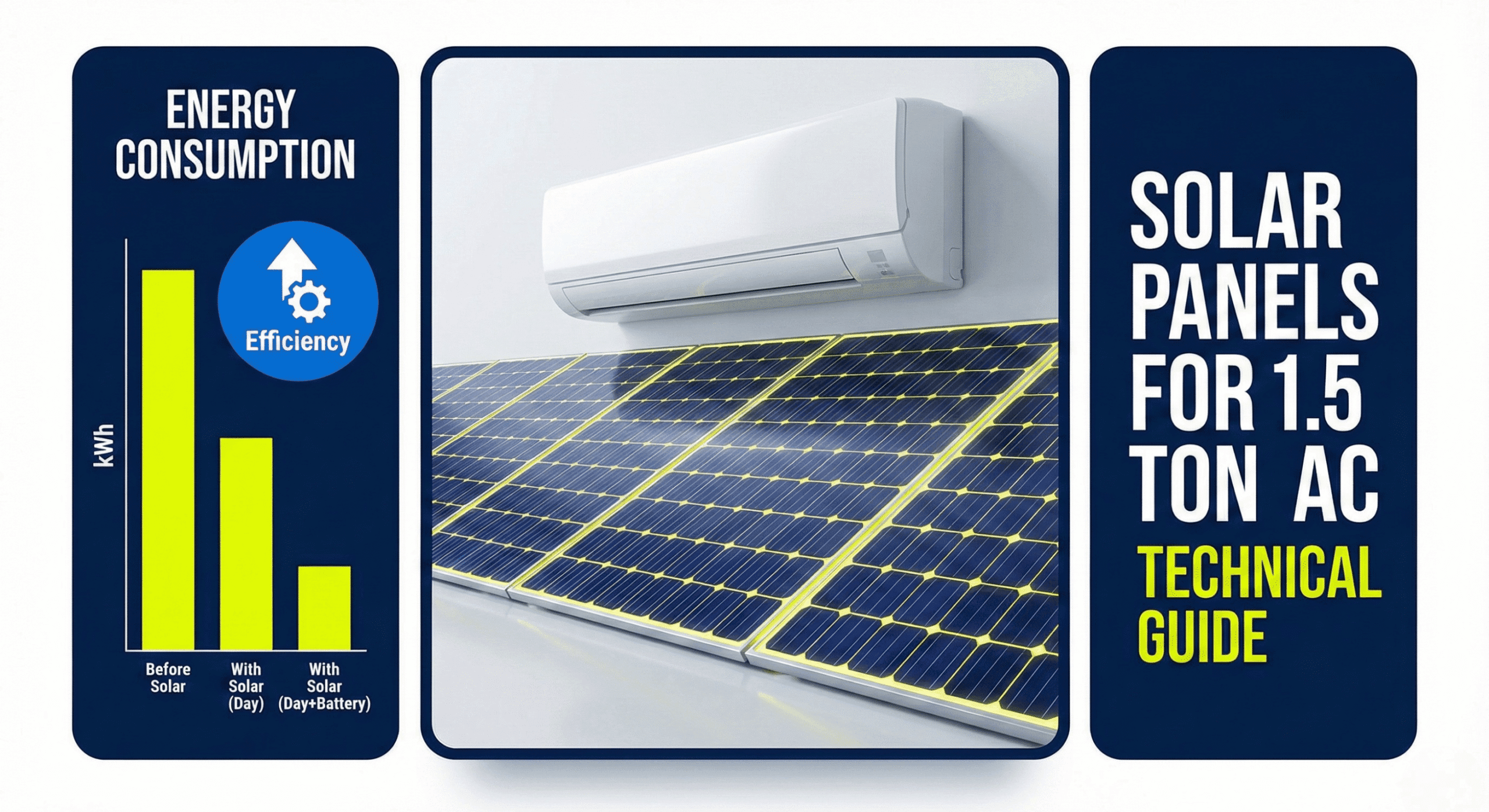
I fried my first inverter trying to figure out exactly how much solar panel required for 1.5 ton ac units.
It was a hot Tuesday in May. I thought my modest 2kW setup could handle a generic Voltas 1.5-ton split unit. The math seemed fine on paper. The AC was rated at 1600 watts. My solar was producing 1800 watts. Easy, right?
Wrong.
The moment the compressor kicked in, the lights flickered, the inverter screamed, and everything went dark. Why? Because I ignored “Surge Currents.” The internet is full of “theoretical” math, but if you want to know the real answer to how much solar panel required for 1.5 ton ac without blowing up your hardware, you need to ignore the sticker wattage.
Here is the jagged, messy truth about running your AC on solar.
1. The “Surge” Trap (Why Your Math is Wrong)
Most people look at the sticker on their AC unit. It says “1550 Watts.” So they buy 1600 Watts of panels.
This is a recipe for disaster.
A non-inverter AC requires a massive jolt of electricity—up to 3x its running wattage—just to start the compressor. That 1.5-ton beast might need 4500 watts for a split second. If you underestimate how much solar panel required for 1.5 ton ac startup surges, your inverter will trip immediately.
Even with modern Inverter ACs (which start slower), you cannot match the wattage 1:1. You need headroom.
The Rule: Always oversize your inverter capacity by at least 25% over the AC’s peak load.
2. The Golden Number: How Much Solar Panel Required for 1.5 Ton AC?
Let’s cut to the chase. I’ve run the numbers for both standard and high-efficiency units.
To run a 1.5-ton AC comfortably during peak sun hours (10 AM – 3 PM), you need a minimum system size of 3 kW.
Here is the breakdown using modern 550W Mono-PERC panels:
- System Size: 3 kW to 3.5 kW
- Number of Panels: 6 to 8 Panels (550W each)
- Daily Generation: ~12–15 Units (kWh)
- AC Consumption (8 Hours): ~10–12 Units
Why 8 panels?
Because clouds happen. Dust happens. If you have exactly 6 panels, a single passing cloud drops your voltage, and your AC shuts off. Or worse, it pulls grid power at the highest tariff rate. You need that buffer.

3. The “Nighttime” Nightmare (Batteries)
This is where the dream usually dies.
Running an AC during the day is relatively cheap. Running it at night? That is expensive.
Solar panels do not work at night. Obviously. So, you need batteries. But calculating how much solar panel required for 1.5 ton ac at night changes the math entirely. To run it for just 4 hours after dark, you need a 48V battery bank (typically four 150Ah batteries).
In my experience, lead-acid batteries struggle here. They hate being drained quickly. If you are serious about nighttime cooling, you have to look at Lithium-Ferro-Phosphate (LFP) batteries. They last longer but cost nearly as much as the AC itself.
The Strategy: Use the solar panels to “supercool” your room during the day (set it to 22°C). Then, use fans at night. It’s the only way to avoid bankruptcy.
4. Inverter AC vs. Non-Inverter: The Dealbreaker
If you are still using an old, fixed-speed AC, stop.
Throw it away. Seriously.
Attempting to solar-power an old AC is like trying to fill a bucket that has a hole in the bottom. The specific answer to how much solar panel required for 1.5 ton ac depends heavily on the star rating. An old 3-star AC might chew through 2000 watts continuously. A 5-star Inverter AC might drop down to 600 watts once the room is cool.
The difference in solar requirement:
- Old AC: Requires ~4kW Solar System (Expensive).
- 5-Star Inverter AC: Requires ~2.5kW Solar System (Manageable).
Upgrading the AC is cheaper than buying extra panels.
5. My Recommended Setup (The “Safe” Build)
If a client asks me how much solar panel required for 1.5 ton ac for a trouble-free experience, I don’t give them the bare minimum. I give them the “Safe Build.”
- Inverter: 5 kVA Hybrid Inverter (handles the surge effortlessly).
- Panels: 8 x 550W Bifacial Panels (Total 4.4 kW).
- Battery: 4 x 200Ah Tall Tubular Batteries (for backup, not full night usage).
Why this specific setup?
Because you have other loads. You have a fridge. You have Wi-Fi. If you size the system only for the AC, you will trigger a shutdown the moment someone turns on the microwave.
Is It Worth It?
Financially? Yes, but only if you have high grid tariffs (above ₹7 or $0.15 per unit).
If you are paying cheap rates for grid power, the ROI (Return on Investment) for a battery-heavy solar setup might be 7+ years. But if you face frequent power cuts? The comfort is priceless.
So, are you ready to install this, or will you stick to the grid? The sun is free, but the hardware definitely isn’t.
Internal Link Suggestion: Check out my guide on Best Inverter Battery for Home if you plan to run this at night.
External Link Placeholder: Check out our other post guftugu.in.