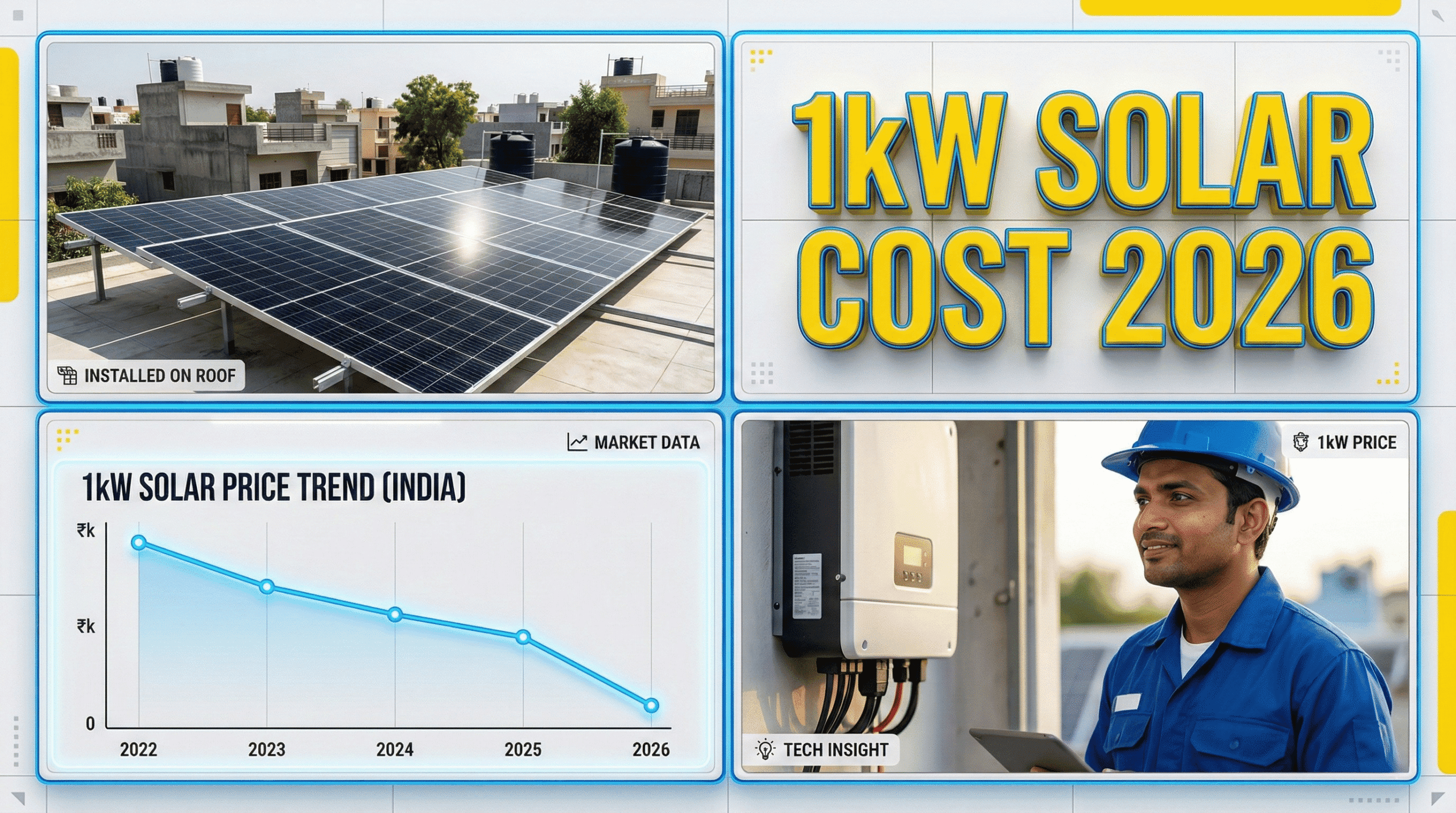
I watched my neighbor spend nearly ₹90,000 on a small rooftop setup two years ago. Last month, I installed a similar system for less than half that out-of-pocket. The difference? I didn’t just buy hardware; I timed the policy shift perfectly.
If you’re hunting for the current 1kW solar panel price in India, the “sticker price” you see on some generic websites is a total lie. Between the PM Surya Ghar Muft Bijli Yojana and the aggressive price war between Tier-1 manufacturers like Tata and Waaree, the math has shifted. Think of this as a 25-year shield against your DISCOM’s inevitable rate hikes. It’s not an expense; it’s a lock-in.
The Raw Numbers: 1kW Solar Panel Price Breakdown
Stop looking at the total bill for a second. Let’s talk about the gear. You’re likely looking at 2 or 3 high-wattage panels—Mono PERC is the standard, but N-Type TOPCon is the new king of efficiency.
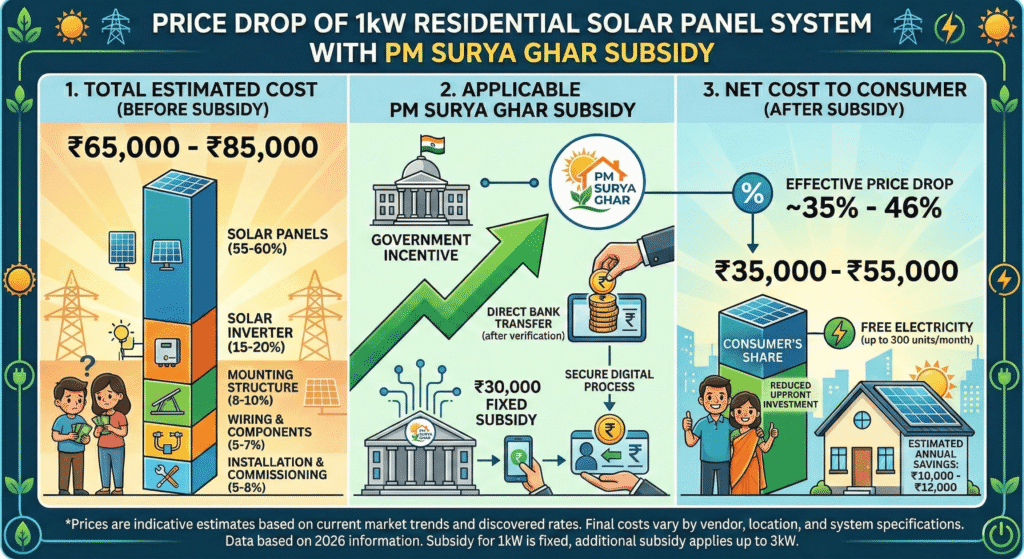
| System Type | Gross Price (2026) | After Subsidy (Estimate) |
| On-Grid (Best ROI) | ₹65,000 – ₹85,000 | ₹35,000 – ₹45,000 |
| Off-Grid (Battery Heavy) | ₹90,000 – ₹1,20,000 | Zero Govt Help |
| Hybrid (The Best of Both) | ₹1,10,000 – ₹1,40,000 | Minor State Perks |
Why the price gap?
Components. Plain and simple. I spent an extra ₹5,000 to ditch a generic “local” inverter for a Growatt unit. Best money I ever spent. Why? Because while my neighbor’s “budget” system tripped every time a cloud passed over, mine kept humming.
And don’t get me started on the mounting. If your installer uses thin MS angles instead of hot-dip Galvanized Iron (GI), your 1kW solar panel price savings will vanish when the structure rusts out in three years. Demand GI. No excuses.
PM Surya Ghar: The ₹30,000 Game Changer
The government isn’t just encouraging solar; they are subsidizing it at a flat rate now. For a 1kW installation, you get a fixed Central Financial Assistance (CFA) of ₹30,000.
And.
In states like Uttar Pradesh or Delhi, you can stack state-level incentives on top. In Lucknow, for instance, the 1kW solar panel price can effectively drop to ₹30,000 total after the ₹15,000 state bonus kicks in.
But there is a catch. To get this money, you MUST use DCR (Domestic Content Requirement) panels. These are modules where the solar cells and the assembly are both done in India. If you buy imported high-efficiency panels from a non-empanelled vendor? Zero subsidy.
Top Brands: Tata vs. Waaree vs. Adani
I spent three weeks comparing quotes from local installers. Here is the reality of the 1kW solar panel price by brand for 2026:
- Tata Power Solar: The “Old Guard.” You pay a premium (about ₹32-35 per watt) for the name. Their panels are workhorses, especially the older Polycrystalline units, but their Mono PERC range is where the value lies now.
- Waaree Energies: Currently India’s largest manufacturer. Their N-Type TOPCon panels are reaching 22% efficiency. They are often ₹2,000–₹3,000 cheaper than Tata for a full 1kW kit.
- Adani Solar: Known for massive scale. Their modules are increasingly found in residential kits because of their high wattage (540W+ panels), meaning you only need two panels to hit your target.
Electricity Savings: Is it Worth It?
A 1kW system isn’t going to run your 2-ton AC all day. Let’s be real. However, it will generate roughly 4 to 5 units of electricity per day. That’s 120–150 units a month.
If your slab rate is ₹7 per unit, you’re looking at ₹1,000 monthly savings. That’s ₹12,000 a year. If your net 1kW solar panel price after subsidy was ₹40,000, your payback period is just over 3 years. After that? The next 22 years of power are essentially free.
Avoid These 3 “Budget” Traps
- The “Sub-₹30,000” Quote: If an installer offers you a 1kW system for ₹25,000 without explaining the subsidy, run. They are likely using “B-Grade” cells or non-branded Chinese inverters that won’t pass DISCOM inspection for net metering.
- Ignoring Roof Strength: 1kW of panels weighs about 60–80kg. If your shed or old RCC roof is crumbling, the “cheap” solar installation will become a very expensive roof repair.
- Cable Thinning: Many vendors save money by using 4sq mm cables when 6sq mm is needed for long runs. This causes “voltage drop,” meaning your 1kW system only performs like an 800W one.
The “Information Gain” Reality Check
Most people think solar is a “set and forget” investment. It isn’t. I learned the hard way that dust is the enemy. Living near a busy road in Noida, I noticed my generation drop by 15% in just three weeks because of a thin layer of grime. If you don’t plan for a water point on your roof, you’re throwing money away.
Component Breakdown for 1kW
- Panels (2-3): ₹25,000 – ₹35,000
- Inverter (1kW On-grid): ₹8,000 – ₹15,000
- Structure & Earthing: ₹10,000 – ₹15,000
- Installation & Net Metering Charges: ₹10,000 – ₹15,000
How to Claim Your ₹30,000 Subsidy
The process is more digital than it used to be. You don’t need to bribe a local officer anymore; you need a smartphone and the PM Surya Ghar portal.
- Register: Use your consumer number from your latest electricity bill.
- Feasibility Approval: Your DISCOM will check if your transformer can handle more solar input.
- Installation: Use only an empaneled vendor. I cannot stress this enough. If they aren’t on the official list, your 1kW solar panel price will never get that ₹30,000 reduction.
- Net Metering: The DISCOM installs a two-way meter.
- DBT Credit: The money hits your bank account within 30 days of the inspection report.
Why 1kW is the “Starter Drug” of Clean Energy
For a small house with 2 fans, a fridge, and 5 LED bulbs, 1kW is perfect. It offsets your base load.
But.
If you plan on getting an EV or an extra AC in the next two years, 1kW is a mistake. The cost of upgrading from 1kW to 3kW later is much higher than just installing 3kW today. Think of the 1kW solar panel price as your entry point, but always leave space on the mounting structure for one more panel.
Comparing State-Wise 1kW Solar Panel Price Variations
- Delhi: High GBI (Generation Based Incentive) makes it the most profitable city for solar.
- Gujarat: The fastest approval times in the country.
- Maharashtra: High base electricity rates mean your ROI is faster even with slightly higher installation costs.
Final Verdict on the 1kW Solar Panel Price
In 2026, paying more than ₹45,000 (net) for an on-grid 1kW system is overpaying. The technology has matured, the supply chain is domestic, and the subsidies are at an all-time high.
So, are you ready to stop paying the full DISCOM bill?
The PM Surya Ghar portal is open, and prices are the lowest they’ve been in five years. If you have 100 sq. ft. of shadow-free space, there is no reason to wait.
What’s holding you back—the upfront cost or the technical headache?
Internal Link: 5 Insane Topcon Solar Panel Wins (That Save Lakhs) in India 2026